Industrial Manufacturing
North American Light Rail Construction Spending Could Top $19 Billion in 2005
Currently, Industrialinfo.com is tracking 28 new or expansion projects in the Light Rail Industry in North America, with an anticipated construction kick-off in 2005 - Includes 2005 U.S. Light Rail Capital Analysis Charts and Graphs
Released Wednesday, October 06, 2004

Researched by Industrialinfo.com (Industrial Information Resources, Incorporated Houston, Texas). The Light Rail Industry has seen dramatic growth as a means of transportation in the United States. In recent years, Light Rail spending across North America has been on the rise, a trend that will continue into 2005.
Light rail is defined on the North American Light Rail Terminology website as an electrical wire-powered railway system characterized by its ability to operate single or multiple cars along exclusive rights-of-way at ground level, on aerial structures, in subways, or in streets, and capable of boarding and discharging passengers at station platforms or at street, track, or car-floor level.
Currently, Industrialinfo.com is tracking 28 new or expansion projects in the Light Rail Industry in North America, with an anticipated construction kick-off in 2005 valued at over $19 billion. Geographically speaking, California, Maryland, Texas, British Columbia, and New Jersey are the front-runners in overall spending.
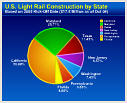 Click on the image at right to view the 2005 Light Rail Capital Spending Distribution by State Chart/
More than fourteen cities in the United States have added light rail transportation to their landscape, some where no other fixed-guideway form of transit had ever existed. In 1981, San Diego became the first United States city to open a new light rail line since the days of the streetcars. The initial 16-mile (25.8 km) line operated from downtown San Diego to San Ysidro, at the Mexican border. Currently in North America, there are approximately 25 light rail systems in operation, with more systems under construction or proposed in the years to come.
The future of light rail transit development is dependent on what occurs at the local and national governmental levels. In order for light rail projects to succeed broad-based community support and local funding have to be acquired, based on estimated ridership figures and benefits to the community, outweighing the expected construction and operating costs.
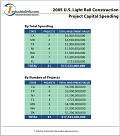 Click on the image to the right to view the 2005 Light Rail Capital Spending Analysis Table.
The federal government has also started questioning the future of light rail projects and has developed a new rating program, analyzing both finance and project justification. It has also developed a new start-rating program for light rail projects, in terms of high, medium-high, medium, low, low-medium, or low. Each project will be given a rating as to its actual justification and to the measures for local financial commitment. The federal government is starting to recognize the heavy cost for these light rail systems and that they are not relieving congestion and cost-benefit ratios.
Ultimately, the future of light rail could lie squarely on the shoulders of the everyday citizen. In addition to the federal funding required to get these projects off the ground, the developers of the light rail industry, nine times out of ten, the city hosting the project, must ask the taxpayer to support the evolution of transportation technology in the form of bonds to help finance the light rail systems. With its environmentally friendly system of transportation, to date, the taxpayer has been willing to help with the funding necessary for these projects to move forward. This, along with a federal government that is willing to continue to support its development, will be the catalyst that allows the light rail industry to continue to grow and develop in the years to come.
For more information on Light Rail Projects in North America, check out Industrialinfo.com's North American Industrial Database or call our Member Center at 1-800-762-3361.
Want More IIR News Intelligence?
Make us a Preferred Source on Google to see more of us when you search.
Add Us On GoogleAsk Us
Have a question for our staff?
Submit a question and one of our experts will be happy to assist you.

Forecasts & Analytical Solutions
Where global project and asset data meets advanced analytics for smarter market sizing and forecasting.
Explore Our SolutionsRelated Articles
-
Data Centers Push Vistra to Grow U.S. Nuclear, Natural Gas F...August 25, 2026
-
Typhoon Saudel Threatens Okinawa, Eastern ChinaAugust 25, 2026
-
China's 'New Type' Power Storage Now Half of Global CapacityAugust 24, 2026
-
Evergy Sees Opportunities in Midwest's Data Center BuildoutAugust 19, 2026

PECWeb Global Market Intelligence Platform
Identify opportunities, anticipate change, and execute with confidence. PECWeb connects the industrial intelligence you need, from projects and assets to operational events, all in one platform.
Discover PecwebIndustry Intel
-
European Chemicals and Transport Fuels OutlookPodcast Episode / Jul 10, 2026
-
2026 European Petroleum Refining Project OutlookPodcast Episode / Jun 26, 2026
-
Brazil: Efficiency, Innovation, and Opportunities in the Food & Beverage IndustryPodcast Episode / Jun 12, 2026
-
2026-2027 Investment Radar for Mexico, Central America & the CaribbeanPodcast Episode / May 29, 2026
-
Innovations Shaping the Next Era of Power GenerationPodcast Episode / May 22, 2026