Middle East
Renewables, Natural Gas were Biggest Winners in Global Energy Use in 2024
Global energy demand rose 2.2% in 2024, a faster than average pace when compared with the prior decade
Released Monday, March 24, 2025

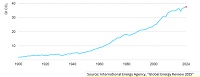
Written by John Egan for Industrial Info Resources (Sugar Land, Texas)--Global energy demand rose 2.2% in 2024, a faster-than-average pace when compared with the prior decade, according to a new report from the International Energy Agency (Paris, France). Demand from the global power sector surged about 4.3% last year, nearly double the overall growth in energy use, the agency said it its Global Energy Review 2025 report, released on Monday.
Electricity demand growth, at 4.3%, outstripped worldwide gross domestic product (GDP), which increased 3.2%, as well as broader energy use (2.2%).
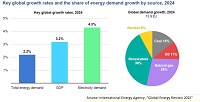
Last year, renewables accounted for most of the growth in global energy supply (38%), followed by natural gas (28%), coal (15%), oil (11%) and nuclear (8%), the report noted. Solar generation continued its trend of strong growth: It set another record for capacity additions last year, placing over 700,000 megawatts (MW) of new capacity in service in 2024.
For the global electricity segment, demand growth was driven by higher demand for cooling, rising consumption by rising temperatures, industrial expansion, the electrification of transport and the growth of data centers and artificial intelligence in 2024, the IEA said.
The Global Energy Review report quantified the high reliance on coal to generate electricity in India, China and Southeast Asia. It contrasted that high market share with coal's low market share in the electric fuels mix in the U.S and the European Union (EU). Overall, slightly less than 40% of the world electricity is generated from coal.
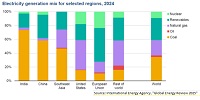
Natural gas, which generated about 38% of electricity in the U.S. last year, had a larger role in the U.S. electric fuels mix than any other global region last year, the report said.
Carbon dioxide (CO2) emissions from the energy sector continued to increase in 2024 but at a slower rate than in 2023. A key driver was record-high temperatures and droughts in China and India, which reduced hydropower output and forced those countries to increase their use of coal to generate electricity. Adverse weather patterns accounted for about half of the increase in CO2 emissions worldwide last year, the IEA said. But the continued rapid adoption of clean energy technologies limited emissions growth. The energy agency estimated that clean energy technologies lowered CO2 emissions from energy about 2.6 billion tonnes of additional CO2 emissions in 2024.
In a statement accompanying the release of the report, IEA Executive Director Fatih Biro said, "What is certain is that electricity use is growing rapidly, pulling overall energy demand along with it to such an extent that it is enough to reverse years of declining energy consumption in advanced economies. The result is that demand for all major fuels and energy technologies increased in 2024, with renewables covering the largest share of the growth, followed by natural gas. And the strong expansion of solar, wind, nuclear power and EVs (electric vehicles) is increasingly loosening the links between economic growth and emissions."
The IEA's major findings are summarized below.
Oil
Global demand for oil rose about 0.8% in 2024, about 830,000 barrels per day, which was a nearly 60% decrease from the prior year's growth of 1.9%. Oil demand from global road transport fell slightly year-over-year, driven by declines in China and advanced economies, the IEA report said, adding that remote work accounted for a significant reduction in vehicle miles traveled in some markets, such as the U.S. However, oil demand grew from aviation and petrochemicals.
In the road transport sector, the rise of EVs caused oil usage to flatten last year. EV car sales continued to rise globally in 2024, increasing by more than 25% compared to 2023. Globally, about 17 million EV units were operating in 2024, up from 14 million in 2023. EVs accounted for over 20% of all car sales in 2024, the IEA reported.
For the first time, oil accounted for less than 30% of primary energy use around the world at the end of 2024. Oil peaked at 46% of primary energy five decades ago, the agency report observed.
Natural Gas
Among fossil fuels, natural gas saw the strongest global demand growth in 2024, rising 2.7%, or approximately 115 billion cubic meters (Bcm), which is about 4 trillion cubic feet (Tcf). Annual average gas demand growth averaged significantly less than that, about 75 Bcm, or 2.6 Tcf, over the prior decade.
The IEA report said worldwide demand for gas reached an all-time high last year, and that over three-quarters of that growth came from emerging markets and developing economies. Last year's 2.7% growth rate exceeded annual average demand growth of about 2% over the 2010-2019 period, the IEA said. During the COVID-19 pandemic and global energy crisis following Russia's invasion of Ukraine, global gas demand increased by about 1% per year, it observed.
Last year, China had the largest absolute growth in gas demand, over 30 Bcm, or about 1 Tcf. Demand growth also was strong in other emerging and developing economies in Asia. In the U.S., gas demand rose 2%, which is roughly 20 Bcm or 0.7 Tcf. The EU experienced a modest growth in use of gas last year, mainly driven by industrial uses. Demand growth for gas in Russia last year outstripped U.S. demand growth.
Around the world, the Electric Power industry and a variety of other industries, including the Chemical Processing industry, drove year-on-year growth in demand.
Renewables
The IEA report said that approximately 80% of the growth in global electricity generation last year came from renewables and nuclear power.
Last year, new renewable electric generation hit record levels for the 22nd consecutive year, with around 700,000 megawatts (MW) of total renewable capacity coming online. Nearly 80% of that came from solar photovoltaics (PV).
In 2024, generation from solar PV and wind increased by a record 670 terawatt-hours (TWh), the IEA said, while generation from natural gas rose by 170 TWh and coal by 90 TWh. In the EU, the share of generation provided by solar PV and wind surpassed the combined share of coal and gas for the first time. In the U.S., solar PV and wind's share rose to 16%, overtaking that of coal. In China, solar PV and wind reached nearly 20% of total generation.
The report said strong growth in electric demand came from increasing cooling demand resulting from extreme temperatures, growing consumption by industry, the electrification of transport, and the expansion of the data center sector. The installed capacity of data centers globally increased by an estimated 20%, or around 15 gigawatts (GW), mostly in the U.S. and China.
Nuclear
More than 7,000 MW of new nuclear power capacity began operating in 2024, roughly 33% more than in 2023, the IEA said. Construction starts for nuclear power plants grew by 50% in 2024. Developers relied exclusively on Chinese and Russian reactor designs last year.
Industrial Info Resources (IIR) is the leading provider of industrial market intelligence. Since 1983, IIR has provided comprehensive research, news and analysis on the industrial process, manufacturing and energy related industries. IIR's Global Market Intelligence (GMI) platform helps companies identify and pursue trends across multiple markets with access to real, qualified and validated plant and project opportunities. Across the world, IIR is tracking over 200,000 current and future projects worth $17.8 Trillion (USD).
/news/article.jsp
false
Want More IIR News Intelligence?
Make us a Preferred Source on Google to see more of us when you search.
Add Us On GoogleAsk Us
Have a question for our staff?
Submit a question and one of our experts will be happy to assist you.

Forecasts & Analytical Solutions
Where global project and asset data meets advanced analytics for smarter market sizing and forecasting.
Explore Our SolutionsRelated Articles
-
The Answer Age: How Industrial Info Is Bringing Trusted Data...August 26, 2026
-
New LNG Projects Offsetting Some Supply-Side Issues, Study F...August 25, 2026
-
Global Power Construction Spending Led by Nuclear, WindAugust 24, 2026
-
U.S. Drivers Weary as Gas Station Prices at August HighAugust 24, 2026
-
Middle East Fighting Escalates with Refiners in the Crosshai...August 10, 2026

PECWeb Global Market Intelligence Platform
Identify opportunities, anticipate change, and execute with confidence. PECWeb connects the industrial intelligence you need, from projects and assets to operational events, all in one platform.
Discover PecwebIndustry Intel
-
European Chemicals and Transport Fuels OutlookPodcast Episode / Jul 10, 2026
-
2026 European Petroleum Refining Project OutlookPodcast Episode / Jun 26, 2026
-
Brazil: Efficiency, Innovation, and Opportunities in the Food & Beverage IndustryPodcast Episode / Jun 12, 2026
-
2026-2027 Investment Radar for Mexico, Central America & the CaribbeanPodcast Episode / May 29, 2026
-
Innovations Shaping the Next Era of Power GenerationPodcast Episode / May 22, 2026
