Power
Summer 2026 Outlook: Warmth Across Key U.S. Energy Markets
Summer 2026 forecast favors broad North American warmth, supporting cooling demand and regional weather volatility
Released Monday, June 08, 2026
Written by Aaron Studwell, Ph.D., Energy Meteorologist & Analyst (Sugar Land, Texas)
Summary
The upcoming summer is expected to bring widespread warmth across key domestic population centers. This supports increased cooling demand, coupled with increasing wildfire, drought, and severe weather risks.A Long, Hot Summer
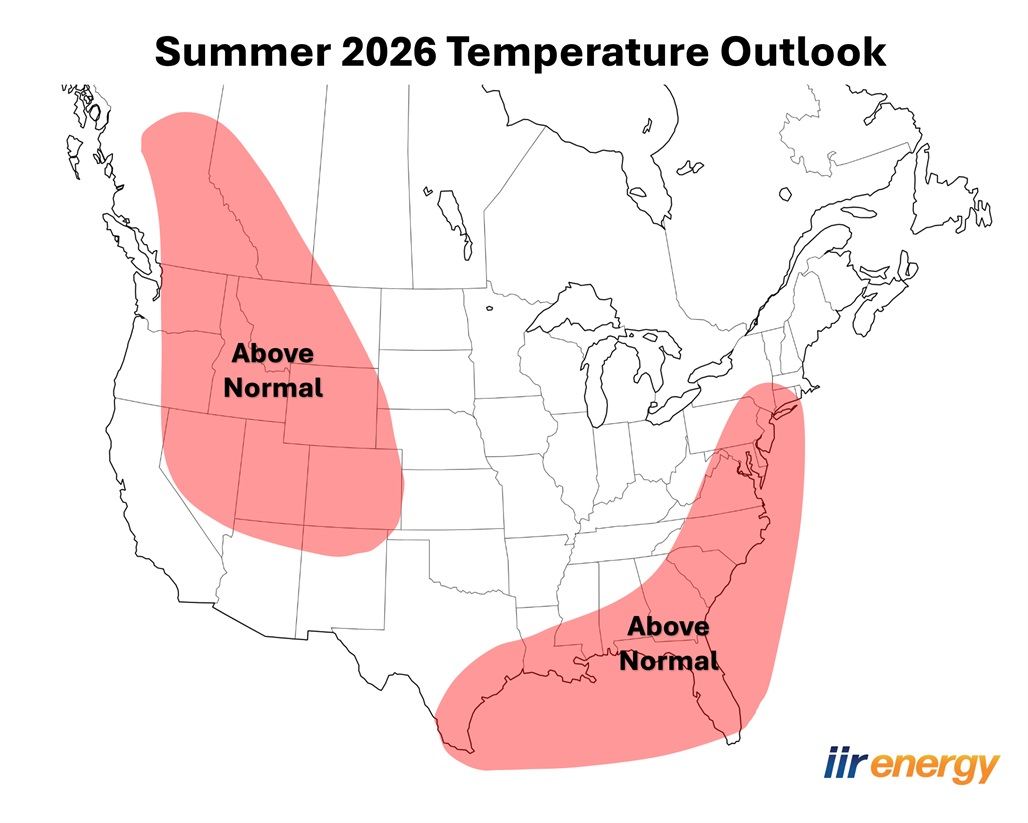
The Industrial Info Resources Summer Outlook points to a warmer-than-normal season for much of North America. However, the heat signal is not evenly distributed. The strongest warmth is favored across the western U.S., Gulf Coast and East Coast. Elsewhere, the northern Plains, Upper Midwest and Great Lakes carry a weaker, more variable signal. The NOAA's Climate Prediction Center outlook also favors a building El Niño during the summer. However, its strongest North American influence may wait until late summer, even potentially in the upcoming winter season.According to Industrial Info Resources data, this forecast pattern's impact in the summer will be driven by both broad cooling demand and regional weather disruptions. Western heat and dry soils can increase electricity demand, while stressing hydro, increasing wildfire risk, and potentially impacting regional transmission. Farther east, warm and humid periods will raise cooling demand across the eastern third of the U.S. Periodic rainfall and cloud cover could temporarily reduce peak loads.
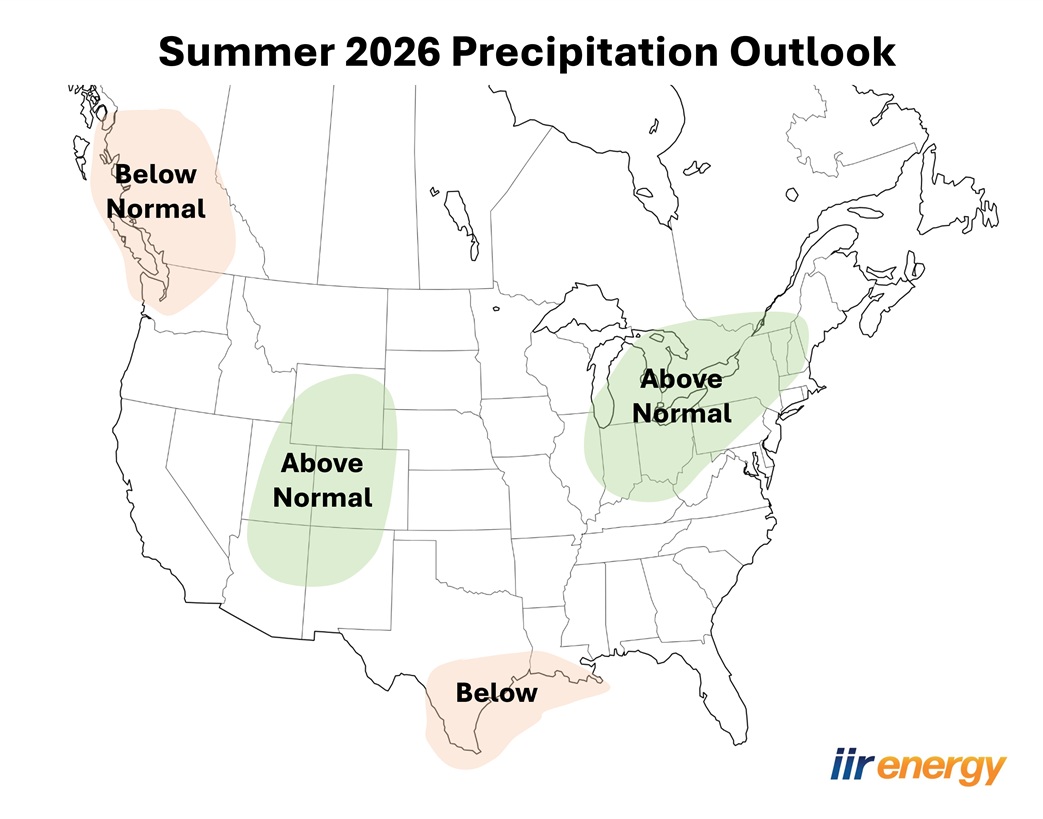
Precipitation guidance also favors a split pattern. The Pacific Northwest, northern Intermountain West, central Rockies and parts of the Plains lean drier than normal. Above-normal precipitation is favored near the Four Corners, parts of the Southeast, and the Atlantic Coast. That sharpening El Niño raises the risk of a strong Southwest monsoon signal, periodic heavy-rain events in the Southeast and Mid-Atlantic, and continued drought or wildfire pressure in portions of the West and Plains.
June: Spring Storm Track Weakens
June is expected to act as the transition month between the late-spring storm pattern and the deeper summer regime. Heat is favored to build across the West, Gulf Coast, Southeast and portions of the East. The northern tier is expected to remain more variable, with occasional cold air intrusion. Periodic troughing near the northern U.S. and southern Canada could still send cold fronts across the Plains, Midwest, Great Lakes and Northeast. That would maintain day-to-day volatility in temperature, cloud cover, wind and power load.For energy markets, June may not produce the strongest national cooling demand of the season, but it can create regional stress. Early heat in California, the Desert Southwest, Texas and the Southeast would increase cooling demand, especially if nighttime temperatures stay elevated. Repeated frontal zones across the central U.S. could support thunderstorms and heavy rainfall, temporarily lowering peak loads but raising outage and logistics risks.
July: Peak Heat Expands Across Much of North America
July is expected to bring a classic summer risk profile, with broader heat coverage, resulting in increased cooling demand. Our outlook favors above-normal temperatures across much of the Lower 48, with the strongest probabilities over the West and continued warm signals along the Gulf Coast and East Coast. The northern Plains, Upper Midwest and Great Lakes may remain less locked into the heat signal than the West or South, but even near-normal July weather can still support meaningful electric load.The West and Southwest will be key focus areas. Dry soils, snowpack deficits and favored below-normal precipitation across parts of the Pacific Northwest, northern Rockies and central Plains can reinforce heat through land-atmosphere feedback. This would increase wildfire risk, reduce soil moisture buffers and raise cooling loads across California and interior western markets.
At the same time, the expected robust monsoon signal near the Four Corners should bring a competing influence. More storms can provide localized drought relief and reduce solar output during active periods, but lightning, outflow winds, flash flooding and debris-flow risk can create operational problems.
In the East, above-normal precipitation chances near the Atlantic Coast and Southeast suggest that humidity, clouds, and storms may be as important as temperature anomalies. That setup can produce high overnight lows, elevated cooling demand, and storm-related outage risk, even if daytime highs are occasionally muted by rain.
August: Persistent Warmth with Growing El Niño Influence
By August, the forecast becomes more sensitive to how quickly El Niño develops and how strongly the atmosphere responds. NOAA notes that El Niño impacts are generally more reliable from late summer into autumn than early summer. If the warm Pacific signal strengthens, it may begin to shift storm tracks and precipitation patterns, though summer convective details will remain regional and difficult to pin down months in advance.The main August signal still favors warmth across much of the U.S., especially the West, Gulf Coast and East Coast. Cooling demand should remain strong, with the highest risk where heat overlaps with humidity, warm nights or dry soils. The Plains are more uncertain; if dryness persists across the central and southern Plains, heat could intensify and raise demand for SPP and ERCOT. If thunderstorm clusters remain active, periodic cloud cover and rain-cooled air could introduce more load volatility.
For Canada, warmer risks should become more important across eastern Canada and parts of the northern tier, while western Canada may remain more exposed to Pacific trough influence and wildfire-smoke variability. Mexico should continue to see strong summer heat outside monsoon-affected areas, with northwestern and north-central Mexico most likely to benefit from seasonal rainfall.
Hold on for El Niño
The June-August outlook favors a warmer-than-normal summer across much of North America, with the strongest and most persistent heat signals across the western U.S., Gulf Coast, East Coast, Alaska, and parts of eastern Canada. The northern Plains, Upper Midwest and Great Lakes carry a less certain temperature signal, leaving more room for periodic fronts and storm-driven variability.The main energy theme is broad cooling demand, not a simple coast-to-coast heat dome. The West faces the strongest combination of heat, dry soils, drought stress, wildfire exposure and possible hydro concerns. The Southeast and Atlantic Coast may see more humidity, rainfall, and storm interruptions, while the Four Corners and northern Mexico trend more active as the monsoon develops. El Niño is likely to become a larger forecast influence later in the season, especially into August and beyond.
Key Takeaways
- Warmer-than-normal conditions are favored across much of North America, with the strongest signals in the West, Gulf Coast, East Coast, Alaska, and eastern Canada.
- The northern Plains, Upper Midwest, and Great Lakes are expected to experience greater temperature variability and a weaker seasonal heat signal.
- Cooling demand should remain broadly elevated through the summer, particularly where heat overlaps with humidity and warm overnight temperatures.
- Below-normal precipitation is favored across parts of the Pacific Northwest, northern Rockies, and portions of the Plains, increasing drought and wildfire concerns.
- Above-normal precipitation is favored across the Four Corners region, Southeast, and parts of the Atlantic Coast, supporting monsoon activity and periodic heavy rainfall.
- El Niño is expected to strengthen during the summer, with its influence becoming more apparent during August and extending into autumn and winter.
About Industrial Info Resources
Industrial Info Resources (IIR) is the leading provider of industrial market intelligence. Since 1983, IIR has provided comprehensive research, news, and analysis on the industrial process, manufacturing, and energy-related industries. IIR's Global Market Intelligence (GMI) helps companies identify and pursue trends across multiple markets with access to real, qualified, and verified plant and project opportunities. Across the world, Industrial Info Resources is tracking over 250,000 current and future projects worth $30.2 trillion (USD).
/news/article.jsp
false
Want More IIR News Intelligence?
Make us a Preferred Source on Google to see more of us when you search.
Add Us On GoogleAsk Us
Have a question for our staff?
Submit a question and one of our experts will be happy to assist you.

Forecasts & Analytical Solutions
Where global project and asset data meets advanced analytics for smarter market sizing and forecasting.
Explore Our SolutionsRelated Articles
-
NextEra Eyes Strong Backlog, Data Center Hub StrategyOctober 23, 2026
-
Winter 2026-27 Outlook: Strong El Niño Expected to Shape Nor...October 23, 2026
-
India Adds 8.2 GWh of Battery Storage Capacity in the First ...October 23, 2026

PECWeb Global Market Intelligence Platform
Identify opportunities, anticipate change, and execute with confidence. PECWeb connects the industrial intelligence you need, from projects and assets to operational events, all in one platform.
Discover PecwebIndustry Intel
-
Brazil Critical Minerals 2027: Rare Earths, Lithium, CopperPodcast Episode / Oct 16, 2026
-
US Craft Labor Outlook 2026: Wages, Per Diems, Data CentersPodcast Episode / Oct 16, 2026
-
Latin America Data Center Outlook 2026: Power, Hubs & GrowthPodcast Episode / Oct 9, 2026
-
Food and Beverage CapEx Outlook 2026: Tariffs, AI, AfricaPodcast Episode / Oct 9, 2026
-
North America Refining 2026: New Pipelines to PADD 5Podcast Episode / Oct 2, 2026