Alternative Fuel
EIA: Some RIN Prices Double in 2026 with Higher Blending Requirements
Updates to U.S. Renewable Fuels Standards greatly increase renewable volume obligations. Industrial Info Resources is following 26 operational RD/SAF units across the U.S.
Released Wednesday, June 24, 2026

Written by Paul Wiseman for IIR News Intelligence (Sugar Land, Texas)
Summary
Updates to U.S. Renewable Fuels Standards greatly increase renewable volume obligations. Industrial Info Resources is following 26 operational RD/SAF units across the U.S.EPA Increases RVOs
On March 27, the U.S. Environmental Protection Agency (EPA) announced its 2026-27 updates to the Renewable Fuels Standards (RFS). Those rules significantly increased renewable volume obligations (RVOs) compared to those of 2025.In the process, the Renewable Identification Numbers (RINs)--equivalent to one gallon of ethanol and used as compliance credits for biomass-based diesel and ethanol--have risen in value, approaching all-time highs on June 4, according to the U.S. Energy Information Administration (EIA).
"RIN prices increase with high RVOs to reflect the higher profit margins biofuel producers need as incentive to produce enough fuel to meet mandates," the EIA said.
Industrial Info Resources is tracking 61 biodiesel (BD)/renewable diesel (RD)/Sustainable Aviation Fuel (SAF) projects in the U.S. expected to kick off April 2026 through December, 2027, with a total investment of $39.85 billion. Industrial Info is also tracking 26 operational RD/SAF units, with nearly 5 billion gallons per year of operational capacity. A further 70 units are planned. The Industrial Info Resources Global Market Intelligence (GMI) Alternative Fuel database includes detailed reports on the projects, operational units and planned units.
Industrial Info's VP Energy Intelligence Hillary Stevenson pointed out, "Higher RIN prices and RVO volumes could provide a tailwind for some of the RD/SAF units being planned. Four units are expected to be added to the U.S. fleet in 2026, compared to only one pilot unit brought online in 2025."
Overall, said the EIA, "As of June 4, biomass-based diesel (D4) RINs traded at $2.41 and ethanol (D6) RINs traded at $2.37, both close to their all-time highs set in 2021. Because one gallon (gal) generates 1.5 RINs for biodiesel and 1.6 RINs to 1.7 RINs for renewable diesel, these fuels currently generate more than $3.50/gal of credits. A gallon of fuel ethanol generates 1.0 credit."
By the Numbers
- $2.41 and $2.37 each: June 4 market prices for biomass-based diesel RINs and ethanol RINs, respectively. This is close to their all-time highs, set in 2021
- 70: Number of planned RD/SAF units Industrial Info Resources is tracking
What Are the New Standards?
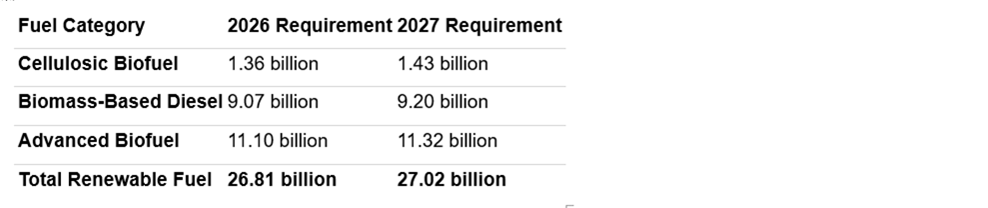
At the top of the list of changes, the new standards freeze conventional corn ethanol at 15 billion gallons while aggressively scaling up requirements for advanced, cellulosic, and biomass-based diesel to support domestic agricultural and biofuel markets. For more information, see May 18, 2026, article - U.S. Renewable Fuels Policy Changes Could Benefit Domestic Farmers.The new standards are as follows:
Why Do Higher Standards Boost RIN Prices?
A standard rule for markets is that when demand for something rises, so does its price, and RINs are no exception. However, there is more to it than just that, especially in markets for biodiesel (an older low-carbon diesel, blended only up to about 20% with the petroleum variety) and renewable diesel (can be a 100% replacement for petroleum diesel).The EIA has a formula for evaluating how much the EPA incentives boost prices. It involves the difference between prices for soybean oil (incentivized) and heating oil (not incentivized). This is called the Bean Oil-Heating Oil (BOHO) spread.
Says the EIA, "Typically, RIN prices move with the BOHO spread to maintain margins. However, when RIN values increase relative to the BOHO spread, as they have done in 2026, profit margins for producing biodiesel and renewable diesel generally improve. The rapid increase in RIN values relative to the BOHO spread in 2026 suggests that the new RVOs are a significant driver of increased RIN values and that biodiesel and renewable diesel production margins are much higher than in 2025."
How and Where Are RINs Traded?
Markets decide prices of oil, natural gas, and basically all commodities. RINs are no different.RINs were created by the EPA as a kind of "currency" to monitor compliance with energy acts of 2005 and 2007, which established standards for use of renewable fuels. When a producer refines a gallon of qualifying fuel, the EPA issues a unique 38-character numeric code--the RIN--attached to it. Refiners and importers must collect and retire RINS to prove they have met their annual volume requirements.
RINs are primarily traded in two places: the over-the-counter spot market, and through Nodal Exchange, the latter in collaboration with IncubEx. Even with that, the physical transfer of RINs occurs through the EPA's Moderated Transaction System (EMTS), but the financial and physically-delivered futures and options contracts go through Nodal Exchange.
Key Takeaways
- New renewable fuel standards have raised the market price of RINs.
- This is encouraging construction of new RD and SAF plants in the U.S.
- Industrial Info Resources is tracking 26 operational RD/SAF units, with 70 more planned.
About Industrial Info Resources
Industrial Info Resources (IIR) is the leading provider of industrial market intelligence. Since 1983, IIR has provided comprehensive research, news and analysis on the industrial process, manufacturing and energy related industries. IIR's Global Market Intelligence (GMI) helps companies identify and pursue trends across multiple markets with access to real, qualified and validated plant and project opportunities. Across the world, Industrial Info Resources is tracking over 250,000 current and future projects worth $30.2 Trillion (USD).
/news/article.jsp
false
Want More IIR News Intelligence?
Make us a Preferred Source on Google to see more of us when you search.
Add Us On GoogleAsk Us
Have a question for our staff?
Submit a question and one of our experts will be happy to assist you.

Forecasts & Analytical Solutions
Where global project and asset data meets advanced analytics for smarter market sizing and forecasting.
Explore Our SolutionsRelated Articles
-
IIR rastrea US$ 25.000 millones en proyectos de etanol en Br...October 21, 2026
-
Brazil Hikes Ethanol Blending Requirements to 32%October 20, 2026
-
Europe's Mild Winter Outlook Tests Natural Gas PreparednessOctober 16, 2026
-
Argentina Positions Itself as SAF HubOctober 13, 2026
-
Gulf Coast Industries Brace for Hurricane IsaiasOctober 09, 2026

PECWeb Global Market Intelligence Platform
Identify opportunities, anticipate change, and execute with confidence. PECWeb connects the industrial intelligence you need, from projects and assets to operational events, all in one platform.
Discover PecwebIndustry Intel
-
Brazil Critical Minerals 2027: Rare Earths, Lithium, CopperPodcast Episode / Oct 16, 2026
-
US Craft Labor Outlook 2026: Wages, Per Diems, Data CentersPodcast Episode / Oct 16, 2026
-
Latin America Data Center Outlook 2026: Power, Hubs & GrowthPodcast Episode / Oct 9, 2026
-
Food and Beverage CapEx Outlook 2026: Tariffs, AI, AfricaPodcast Episode / Oct 9, 2026
-
North America Refining 2026: New Pipelines to PADD 5Podcast Episode / Oct 2, 2026