Alternative Fuel
U.S. Renewable Fuels Policy Changes Could Benefit Domestic Farmers
In the last year, the U.S. has made 'an unprecedented number of policy changes in the biofuels space' at both national and state levels. Changes involve finished products and feedstocks.
Released Monday, May 18, 2026

Written by Paul Wiseman for IIR News Intelligence (Sugar Land, Texas)
Summary
A recent webinar addressed changes in the U.S. biofuels sector.Changing Policies
In the last year, the U.S. has made "an unprecedented number of policy changes in the biofuels space" at both national and state levels. Changes involve finished products and feedstocks. That's how Christoph Berg, executive director for Biofuels Analytics at S&P Global Energy, introduced the firm's webinar entitled, "How U.S. Biofuels Policy Is Reshaping Feedstock Demand." The changes are aimed at both energy independence and farm support, the latter because many feedstocks come from agriculture, he said.According to Industrial Info Resources data, the U.S. has 2,180 renewable fuels projects, totaling $205.11 billion of investment.
In some ways, the U.S. farmer goals are likely to be successful, the webinar participants agreed. The irony is, however, that those policies raising the minimum required biofuels blends could also require more soybean planting, more crush capacity for the soybeans and, ironically, more imports. The latter because U.S. domestic feedstock supply does not meet total feedstock demand.
Pillars of Policy
The renewable fuel market in the U.S. is governed mainly by two regulations: the Renewable Fuel Standard (RFS) and the Clean Fuel Production Credit (45Z).Under the Clean Air Act (CAA), the U.S. Environmental Protection Agency (EPA) is required to determine the Renewable Volume Obligations (RVOs) for the RFS annually. Volumes for 2026 and 2027 were finalized in March of 2026, setting the highest renewable fuel volumes in the history of the program, according to the EPA.
RINS are used by refiners and importers to prove compliance with RVOs. The EPA chart below compares volume requirements history with the latest updates.
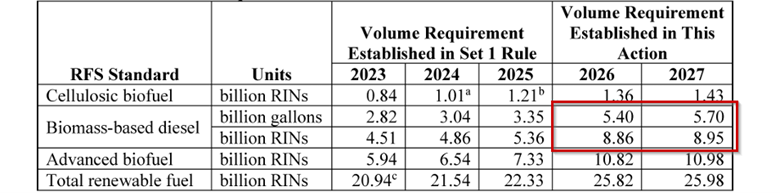
Understandably, Berg pointed out, the higher demand resulting from the increased requirements caused prices (although he did not specify which prices, presumably for D4 biomass-based diesel feedstocks) to rise. He added, "Therefore, more crush capacity is expected to come online."
The 45Z credit, or the Clean Fuel Production Credit, was created under the 2021 Inflation Reduction Act and updated with the One Big Beautiful Bill (OBBB) Act in July 2025. The tax credit is based on a sliding scale of carbon intensity (CI).
"North American farmers were advantaged by the OBBB changes to the 45Z. The OBBB excluded indirect land use changes (ILUC) from emissions rates, which boosted the credit values of soybean and other vegetable oils like canola. Additionally, only U.S., Mexico, and Canada grown and collected feedstocks are allowed for credit eligibility," said Hillary Stevenson, vice president of Energy Intelligence for Industrial Info Resources, commenting for this story.
Feedstock Impacts
RFS and 45Z changes have impacted the feedstock markets. "The biggest trend which we have seen is that the U.S. soybean oil has lost share compared to the imported low CI feedstocks," imported and domestic, said Vasu Tripathy, principal analyst, oils and fats, S&P Global Energy.Waste fats and oils have a lower CI, but supply of these feedstocks is secondary to other processes. Therefore, Tripathy noted, "Given that the supply of domestic lower CI feedstocks tends to be inelastic, as you cannot increase beef demand if you want to produce more tallow, it has become a capping factor out there in the shorter to longer term."
Stevenson added, "Because of the supply shortfalls with total feedstock demand (food-based and waste-based) already exceeding domestic supply, regulations that restrict imported biofuels and feedstocks are likely to be delayed. According to the EPA, regulatory provisions that will reduce the number of RINs generated for imported biofuels and biofuels produced from imported feedstocks beginning in 2028 will be finalized in a future action."
Trade & Benefits
Tripathy believes the U.S. will be short on the required high CI feedstocks, requiring further imports from Canada to meet quotas. Demand will also raise prices for feedstocks of all types, benefitting both U.S. farmers and the crushing industry, as more of both will be required.Key Takeaways
- Recently updated renewable fuels requirements are designed to benefit U.S. farmers and to encourage more domestic feedstock production.
- The goal would be to move toward energy independence and boost revenues for U.S. farmers and biofuels processors.
About Industrial Info Resources
Industrial Info Resources (IIR) is the leading provider of industrial market intelligence. Since 1983, IIR has provided comprehensive research, news and analysis on the industrial process, manufacturing and energy related industries. IIR's Global Market Intelligence (GMI) helps companies identify and pursue trends across multiple markets with access to real, qualified and validated plant and project opportunities. Across the world, Industrial Info Resources is tracking over 250,000 current and future projects worth $30.2 trillion (USD).
/news/article.jsp
false
Want More IIR News Intelligence?
Make us a Preferred Source on Google to see more of us when you search.
Add Us On GoogleAsk Us
Have a question for our staff?
Submit a question and one of our experts will be happy to assist you.

Forecasts & Analytical Solutions
Where global project and asset data meets advanced analytics for smarter market sizing and forecasting.
Explore Our SolutionsRelated Articles
-
IIR rastrea US$ 25.000 millones en proyectos de etanol en Br...October 21, 2026
-
Brazil Hikes Ethanol Blending Requirements to 32%October 20, 2026
-
Europe's Mild Winter Outlook Tests Natural Gas PreparednessOctober 16, 2026
-
Argentina Positions Itself as SAF HubOctober 13, 2026
-
Gulf Coast Industries Brace for Hurricane IsaiasOctober 09, 2026

PECWeb Global Market Intelligence Platform
Identify opportunities, anticipate change, and execute with confidence. PECWeb connects the industrial intelligence you need, from projects and assets to operational events, all in one platform.
Discover PecwebIndustry Intel
-
Brazil Critical Minerals 2027: Rare Earths, Lithium, CopperPodcast Episode / Oct 16, 2026
-
US Craft Labor Outlook 2026: Wages, Per Diems, Data CentersPodcast Episode / Oct 16, 2026
-
Latin America Data Center Outlook 2026: Power, Hubs & GrowthPodcast Episode / Oct 9, 2026
-
Food and Beverage CapEx Outlook 2026: Tariffs, AI, AfricaPodcast Episode / Oct 9, 2026
-
North America Refining 2026: New Pipelines to PADD 5Podcast Episode / Oct 2, 2026