Production
Does the U.S. Ban on Russia Fossil Fuels Even Matter?
A U.S. ban on imported Russian natural gas and crude oil does little to the U.S. energy sector, though the global nature of the market means it will have sweeping ramifications
Released Thursday, March 10, 2022

Written by Daniel Graeber for Industrial Info Resources (Sugar Land, Texas)--A U.S. ban on imported Russian natural gas and crude oil does little to the U.S. energy sector, though the global nature of the market means it will have sweeping ramifications.
U.S. President Joe Biden signed an executive order on Tuesday that bans the domestic import of Russian crude oil, natural gas and refined petroleum products.
"That means Russian oil will no longer be acceptable in U.S. ports, and the American people will deal another powerful blow to (Russian President Vladimir) Putin's war machine," he said.
The price of crude oil eclipsed $120 per barrel shortly after the announcement, but was retracing those steps early in the Wednesday session. Many buyers had already shunned Russian products, and Biden's order allows for a wind-down period of 45 days for existing contracts.
The U.S. economy, however, gets very little crude oil from Russia. In fact, the U.S. Department of Energy reported that, for the week ending February 25, the U.S. economy took in no Russian barrels at all.
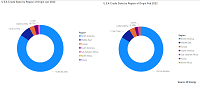 Click on the image at right for a graph detailing crude consumed in the U.S., by place of origin.
From his Twitter handle, President Biden said the U.S. should strive for energy independence. The North American market does indeed look self-reliant based on our latest data. Even the oil-rich Middle East does little for the U.S. market, with the mighty Saudi Arabia ranking a distant third behind Mexico in terms of top suppliers. Canada by far is the largest source of foreign oil moving through the U.S. energy sector.
Commodity markets, however, do not recognize national borders. With inflation already running red hot, the U.S. economy will not be isolated from the collateral damage of sanctions. We see that today with record-high retail gasoline prices.
Recently, we explored the notion presented by U.S. political scientists Robert Keohane and Joseph Nye that a globalized market left various players with various degrees of exposure to risk. A nation that's sensitive to a global trade issues would feel the pain--something we see today at the pump--but would otherwise not be heavily impacted.
But our data show that's simply not the case for the Europeans. According to Keohane and Nye's logic, the European market is vulnerable because of its heavy dependence on Russian fossil fuels.
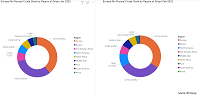 Click on the image at right for a graph detailing crude consumed in Europe, by place of origin.
There also is a notion that isolated Russian barrels would find a home in the Asian market, but our historic data show the regional market share is dominated by Middle East producers. For Asian economies, Russia only accounts for about 10% of the regional refinery slate.
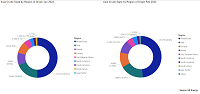 Click on the image at right for a graph detailing crude consumed in Asia, by place of origin.
Nevertheless, it will be difficult in the short-term to find a replacement for what could be the eventual isolation of some 4 million barrels per day of Russian crude oil. Shale crude oil is of a light, sweet variety, though Mars (medium-density, high-sulfur crude) from the Gulf of Mexico and oil from the North Slope of Alaska are similar to the medium, sour crude that Russia mostly exports.
Elsewhere, replacements could come from Kuwait, Oman, southern Iraq, Brazil or Saudi Arabia. But of those, only Saudi Arabia has any meaningful spare capacity to add to the market.
In the meantime, some of the pain may already be baked in, as the market anticipated an ever-tightening financial noose on Russia in response to its military invasion of Ukraine. But with no signs of easing inflationary pressures, the economic blowback may be felt on both sides of the conflict.
Industrial Info Resources (IIR), with global headquarters in Sugar Land, Texas, six offices in North America and 12 international offices, is the leading provider of global market intelligence specializing in the industrial process, heavy manufacturing and energy markets. Industrial Info's quality-assurance philosophy, the Living Forward Reporting Principle, provides up-to-the-minute intelligence on what's happening now, while constantly keeping track of future opportunities. Follow IIR on: LinkedIn.
/news/article.jsp
false
Want More IIR News Intelligence?
Make us a Preferred Source on Google to see more of us when you search.
Add Us On GoogleAsk Us
Have a question for our staff?
Submit a question and one of our experts will be happy to assist you.

Forecasts & Analytical Solutions
Where global project and asset data meets advanced analytics for smarter market sizing and forecasting.
Explore Our SolutionsRelated Articles
-
Both Coasts of Canada Enjoying Energy Sector SuccessJune 22, 2026
-
Canada Set New Record in Crude Oil Production in 2025June 19, 2026

PECWeb Global Market Intelligence Platform
Identify opportunities, anticipate change, and execute with confidence. PECWeb connects the industrial intelligence you need, from projects and assets to operational events, all in one platform.
Discover PecwebIndustry Intel
-
Brazil: Efficiency, Innovation, and Opportunities in the Food & Beverage IndustryPodcast Episode / Jun 12, 2026
-
2026-2027 Investment Radar for Mexico, Central America & the CaribbeanPodcast Episode / May 29, 2026
-
Innovations Shaping the Next Era of Power GenerationPodcast Episode / May 22, 2026
-
The Role of Contract Manufacturing in Global Pharma GrowthPodcast Episode / May 8, 2026
-
2026 North American Labor OutlookPodcast Episode / Apr 24, 2026