Production
Dissecting the Response to Energy Price Volatility
Energy prices already had propelled inflation in the U.S. economy to multi-year highs before the war in Ukraine, begging the question of just how high they can go before demand destruction sets in to the detriment of domestic producers
Released Thursday, March 24, 2022
Written by Daniel Graeber for Industrial Info Resources (Sugar Land, Texas)--Energy prices already had propelled inflation in the U.S. economy to multi-year highs before the war in Ukraine, begging the question of just how high they can go before demand destruction sets in to the detriment of domestic producers.
Some economists were fretting about the pace of annual inflation in the runup to the 2021-22 holiday season, as consumer prices soared on the recovery from the worst of the COVID-19 pandemic. Last year, crude oil prices at one point traded in negative territory, and federal data show the U.S. average retail price for a gallon of regular unleaded gasoline was $1.87 during the last week of April 2020.
West Texas Intermediate, the U.S. benchmark for the price of oil, closed trading Tuesday at $111.76 per barrel, and the national average price at the pump is now $4.23 per gallon.
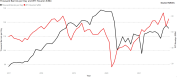 Click on the image at right for a graph detailing U.S production by thousands of barrels per day, versus WTI per-barrel price, by Refinitiv.
Supply-chain issues, an overwhelming level of post-vaccine demand and labor shortages all added up to push consumer prices to historic highs. In Sugar Land, the consumer price index for all urban consumers (CPI-U) was up 2.1% over the first two months of the year.
"Over the last 12 months, the CPI-U rose 7.8%, the largest rise since August 1982," the U.S. Commerce Department stated.
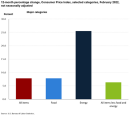 Click on the image at right for a graph from the U.S. Bureau of Labor Statistics on the 12-month percentage change for consumer goods, according to the Consumer Price Index.
Inflation already had been a pressing issue before the war in Ukraine. With energy goods accounting for the bulk--some 25.6% in the latest reading--of inflation, the situation will only get worse going forward, considering the geopolitical risk premium for crude oil.
There may be a silver lining for the U.S. shale patch, however. Before the invasion, climate-conscious investors had pressured major energy companies to invest more in low-carbon alternatives, while at the same time pressing for capital discipline. That meant less spending on upstream.
The war in Ukraine changed that to some degree. U.S. Energy Secretary Jennifer Granholm during the recent CERAWeek energy conference in Houston drew from the Sarah Palin playbook by saying the risk to global energy security warranted an overwhelming response from the U.S. shale patch.
Like war, $100 crude oil can change a lot of things. Energy companies up until late last year were eager to show their social responsibility by speaking in a language that green energy advocates can understand, namely ESG statements. ESG stands for "environmental, social and governance," but those statements have been nudged out of the headlines by concerns about a looming shortage of natural gas, crude oil and refined petroleum products.
Russia is one of the world's leading suppliers of fossil fuels, as well as wheat and other valuable commodities. Crippling economic sanctions over the war in Ukraine, coupled with concerns about broader conflict on the European continent, means those products may be shunned by most of the global market for the foreseeable future.
We've already noted that producers such as Saudi Arabia are looking to capitalize on the Russian void, though that is largely a pursuit for further international leverage. The U.S. shale patch also is set to pounce on the sea change precipitated by the worst European conflict since World War II.
"Our latest survey results point to strong growth in activity, employment and production in the oil and gas sector," said Michael Plante, a senior economist and advisor at the Dallas Fed.
U.S. policy makers and the top brass at domestic energy companies now see shale oil as a source of energy security, ostensibly offering alternatives to some of those missing barrels. Rig counts already were responding to elevated crude oil prices last year, and U.S. shale oil production is on pace to set a record.
The U.S. Energy Information Administration, part of the U.S. Department of Energy, said in its monthly market report for March that full-year 2022 would see an average of 12 million barrels per day in U.S. oil production and that increases another 1 million barrels per day by next year.
The previous record of 12.3 million barrels per day was set in 2019.
But history suggests that behaviors change with the price of oil. The mentality in the shale patch has shifted along with trends in commodity prices. Those prices, however, may be their own undoing.
A daily note from London oil broker PVM suggests that $120-something crude oil is the point at which demand could start to suffer.
"The potential for demand to be adversely affected from sustained high oil prices was always there," analyst Stephen Brennock wrote. "The high oil price has already led the International Energy Agency to revise down its demand growth estimate for 2Q22, 3Q22 and 4Q22 by 1.34 million bpd, 1.45 million bpd and 1.03 million bpd, respectively."
PVM notes it will only get worse before it gets better, pointing to forecasts for $150 per barrel oil. That should incentivize crude oil producers further, but higher crude oil prices are typically their own undoing. Elevated inflation, driven in large part by energy prices, changes the thinking of the everyday consumer as tangible things like bread prices and gas prices leave a black mark on discretionary spending. There already are concerns about a looming recession.
Prior to the war in Ukraine, the mindset for the energy sector was one of transition to a cleaner future. As most of the technologies--hydrogen, carbon re-utilization--are in their nascent stage, the energy transition could be on the back burner.
And yet, climate change is not slowing down and there's still a sense of urgency to do something to avoid irreversible damage in the future.
Stein's Law, formulated by U.S. economist Herbert Stein, states that if something cannot go on forever, it will stop. Unlike recent comments on inflation, commodity prices are by nature transitory. Behaviors, then, wax and wane on the price of oil. Stein's Law then begs the question--is the shale revival transitory too?
Industrial Info Resources (IIR) is the world's leading provider of market intelligence across the upstream, midstream and downstream energy markets and all other major industrial markets. IIR's Global Market Intelligence Platform (GMI) supports our end-users across their core businesses, and helps them connect trends across multiple markets with access to real, qualified and validated project opportunities. Follow IIR on: LinkedIn.
Want More IIR News Intelligence?
Make us a Preferred Source on Google to see more of us when you search.
Add Us On GoogleAsk Us
Have a question for our staff?
Submit a question and one of our experts will be happy to assist you.

Forecasts & Analytical Solutions
Where global project and asset data meets advanced analytics for smarter market sizing and forecasting.
Explore Our SolutionsRelated Articles
-
Pikka Alaska Oil Project Starts Continuous ProductionJune 25, 2026
-
Both Coasts of Canada Enjoying Energy Sector SuccessJune 22, 2026

PECWeb Global Market Intelligence Platform
Identify opportunities, anticipate change, and execute with confidence. PECWeb connects the industrial intelligence you need, from projects and assets to operational events, all in one platform.
Discover PecwebIndustry Intel
-
Brazil: Efficiency, Innovation, and Opportunities in the Food & Beverage IndustryPodcast Episode / Jun 12, 2026
-
2026-2027 Investment Radar for Mexico, Central America & the CaribbeanPodcast Episode / May 29, 2026
-
Innovations Shaping the Next Era of Power GenerationPodcast Episode / May 22, 2026
-
The Role of Contract Manufacturing in Global Pharma GrowthPodcast Episode / May 8, 2026
-
2026 North American Labor OutlookPodcast Episode / Apr 24, 2026