Power
IIR Mid-Year Webinar: COVID-19 Pushes Out Power Projects, but Few Cancellations
On Thursday, Britt Burt, Industrial Info's vice president of research for the Power Industry, gave a mid-year outlook on the North American power sector, including how the industry has been affected by the COVID-19 pandemic.
Released Friday, June 05, 2020
Reports related to this article:
Researched by Industrial Info Resources (Sugar Land, Texas)--On Thursday, Britt Burt, Industrial Info's vice president of research for the Power Industry, gave a mid-year outlook on the North American power sector, including how the industry has been affected by the COVID-19 pandemic. The takeaway: While some North American projects have been pushed out or placed on hold because of the coronavirus, Industrial Info has seen very few outright cancellations, although spending this year in the Power Industry is expected to be lower than originally forecast.
The largest effect the pandemic has had on the U.S. Power Industry has been a significant decline in demand since March, when several states began issuing stay-at-home orders. Commercial and industrial power demand declined by about 4.7%, which was accompanied by a residential demand drop of about 0.8%, thanks to mild weather. In late January, U.S. power demand was at a peak of about 12.3 million megawatt-hours, which dropped down to about 9.8 million megawatt-hours in early March, bottoming out in April at about 8.5 million megawatt-hours. Currently, demand is in the 11 million-megawatt-hour range. Burt said that beginning next year, he expected demand growth to continue at its rate of about 1% per year.
In addition to lower power demand, power generators are facing other causes of economic uncertainty, as many are not cutting off the power to customers with unpaid bills. This uncertainty has led to some project push-out. Delayed projects in North America include nearly $8 billion in new plant construction and more than $3.1 billion in expansions and additions. Among the affected projects is the Darlington Nuclear Unit 3 modernization in Ontario, Canada, and the $1.1 billion Three Rivers Energy Center in Illinois.
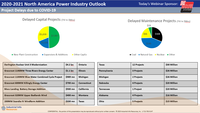 Click on image at right for a snapshot of delayed North American power projects.
The lowered 2020 capital spending seen to date are primarily in wind (2.7% decline), natural gas (23% decline) and solar (19% reduction). Solar, in particular, is facing supply chain disruptions and some labor shortages because of the virus; however, activity is expected to pick up again next year.
The trend in retirements of older energy sources is expected to continue in the future, primarily from coal, which saw about 94 gigawatts (GW) retired from 2010 through 2019 and is expected to see another 60 GW of retirements through 2030. This is expected to be replaced, in large part, by renewable energy, as well as some new natural gas-fired generation.
The renewable power build-out in the U.S. is being driven by the Production Tax Credit (PTC) for wind and the Investment Tax Credit (ITC) for solar. However, these will probably not be around forever. Politicians proposed extending these incentives into the future in the U.S. stimulus bill passed in the wake of COVID-19; however, this did not make it into the final version of the stimulus package, and whether the credits are extended further remains to be seen. However, renewable projects also are being driven by states' Renewable Energy Portfolios (RPS), which mandate a certain amount of power come from renewable or carbon-free sources. While wind and solar remain the dominant forms of renewable energy, Burt said there was room for about 15 GW of added hydropower through projects such as pumped-storage facilities and adding power to existing dams.
While construction of natural gas-fired plants in the U.S. has slowed from the bubble seen a few years earlier, it remains a significant driver in new North American power generation. Speaking of natural gas, Burt said, "We're tracking about 8 GW that's under construction across the United States right now, and I wouldn't be a bit surprised if we see a continuation of some buildout on that. Most of it is combined-cycle combustion turbines. We're seeing more and more of the single-shaft combined-cycle units being installed." Burt said single-cycle units would continue to be built to support renewable energy until battery storage comes more up to speed.
Industrial Info Resources (IIR), with global headquarters in Sugar Land, Texas, six offices in North America and 12 international offices, is the leading provider of global market intelligence specializing in the industrial process, heavy manufacturing and energy markets. Industrial Info's quality-assurance philosophy, the Living Forward Reporting Principle, provides up-to-the-minute intelligence on what's happening now, while constantly keeping track of future opportunities. Follow IIR on: Facebook - Twitter - LinkedIn. For more information on our coverage, send inquiries to info@industrialinfo.com or visit us online at http://www.industrialinfo.com.
Want More IIR News Intelligence?
Make us a Preferred Source on Google to see more of us when you search.
Add Us On GoogleAsk Us
Have a question for our staff?
Submit a question and one of our experts will be happy to assist you.

Forecasts & Analytical Solutions
Where global project and asset data meets advanced analytics for smarter market sizing and forecasting.
Explore Our SolutionsRelated Articles
-
Jobs, Nuclear Energy Bolstered in CanadaDecember 09, 2025
-
DOE Awards $800 Million for U.S. SMR DevelopmentDecember 04, 2025
-
Canada, Sweden Embrace Energy in Strategic PartnershipNovember 20, 2025

PECWeb Global Market Intelligence Platform
Identify opportunities, anticipate change, and execute with confidence. PECWeb connects the industrial intelligence you need, from projects and assets to operational events, all in one platform.
Discover PecwebIndustry Intel
-
Brazil: Efficiency, Innovation, and Opportunities in the Food & Beverage IndustryPodcast Episode / Jun 12, 2026
-
2026-2027 Investment Radar for Mexico, Central America & the CaribbeanPodcast Episode / May 29, 2026
-
Innovations Shaping the Next Era of Power GenerationPodcast Episode / May 22, 2026
-
The Role of Contract Manufacturing in Global Pharma GrowthPodcast Episode / May 8, 2026
-
2026 North American Labor OutlookPodcast Episode / Apr 24, 2026