Power
U.S. Power Industry Plans $3.9 Billion in Mercury Reduction Projects as EPA Passes Mercury Emissions and CAIR Reduction Rulings
Both of these rulings will dominate the capital spending plans of coal-fired power generation companies in the U.S. for the next two decades - Includes a chart showing the breakdown of planned mercury emissions reduction projects by state
Released Thursday, March 24, 2005

Researched by Industrialinfo.com (Industrial Information Resources, Incorporated; Houston, Texas). The EPA recently passed the Clean Air Mercury Rule and the Clean Air Interstate Rule (CAIR). Both of these rulings will dominate the capital spending plans of coal-fired power generation companies in the U.S. for the next two decades. One of the goals of the two rules, which will work in conjunction with each other, will be to reduce emissions of mercury produced at new and existing coal-fired power plants in two phases, first, from 48 tons per year to 38 tons per year by 2010. This first phase will be achieved through a cap and trade program, as opposed to a Maximum Achievable Control Technology (MACT) standard, and will take advantage of the mercury emission reductions achieved through previously mandated Clean Air Act rulings to reduce sulfur dioxide (SO2) and nitrogen oxides (NOx) emissions. A second phase further caps mercury emissions at 15 tons per year in 2018. This allows power generators some much needed breathing room as they deal with billions of dollars worth of plant retrofits for SO2 and NOx reductions.
The CAIR aims to reduce SO2 emissions by 70% and NOx emissions by 60% in 28 Eastern and Midwest states by 2015.
According to Janet Gellici, Executive Director of the American Coal Council, "The cap and trade approach allows market forces to drive emissions reduction and also allows time for development of the mercury emissions reduction technology." Currently, mercury emissions reduction technology is in its infancy, with activated carbon injection being the only proven technology.
Power generators have a good start on implementing the Clean Air Mercury Rule. Starting as early as 2001, energy companies have initiated scoping and technology studies on more than 160 mercury reduction projects in the U.S., representing $3.9 billion in total investment value (TIV). These figures derived from Industrialinfo.com's Power Industry Database do not take into account the billions of dollars that the industry is spending on SO2, NOx, and particulate matter emissions reductions as part of the Clean Air Act. Since June 2003, the number of planned mercury reduction projects has essentially doubled, increasing from 76 projects, totaling $2 billion to today's figures. States with the most planned mercury emissions reduction project spending include Texas, Missouri, Georgia, and Ohio.
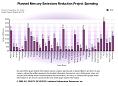 Click on the image at right to view a breakdown of these projects by state.
It is now up to the individual states to adopt the EPA mercury rule, or come up with their own plan, within eighteen months. Each state has a varying budget for mercury emissions and must submit a state plan revision detailing how it will meet its budget for reducing mercury from coal-fired power plants. Some states, such as Massachusetts and New Jersey, have proposed to go beyond the mercury rule and CAIR with caps of 80-90% on mercury, by as early as 2008.
At the same time as the environmental plans are being developed, several coal-belt states, such as Ohio, Indiana, and Illinois, are rallying to attract new coal mine and power plant investment through tax incentives for minemouth power plant construction, featuring new technologies, such as Integrated Gasification Combined Cycle (IGCC). While the permitting time for such facilities can range from seven to ten years, many power generation developers are jumping on the next wave of coal-fired power plant development.
According to the EPA's website on the Mercury Rule - Mercury is a toxic, persistent pollutant that accumulates in the food chain. Mercury in the air is a global problem. While fossil fuel-fired power plants are the largest remaining source of human-generated mercury emissions in the United States, they contribute only a small amount (about 1 percent) of total annual mercury emissions worldwide.
Industrialinfo.com is the leading provider of global industrial market research. We specialize in helping companies develop information solutions to maximize their sales and marketing efforts.
Want More IIR News Intelligence?
Make us a Preferred Source on Google to see more of us when you search.
Add Us On GoogleAsk Us
Have a question for our staff?
Submit a question and one of our experts will be happy to assist you.

Forecasts & Analytical Solutions
Where global project and asset data meets advanced analytics for smarter market sizing and forecasting.
Explore Our SolutionsRelated Articles

PECWeb Global Market Intelligence Platform
Identify opportunities, anticipate change, and execute with confidence. PECWeb connects the industrial intelligence you need, from projects and assets to operational events, all in one platform.
Discover PecwebIndustry Intel
-
Brazil: Efficiency, Innovation, and Opportunities in the Food & Beverage IndustryPodcast Episode / Jun 12, 2026
-
2026-2027 Investment Radar for Mexico, Central America & the CaribbeanPodcast Episode / May 29, 2026
-
Innovations Shaping the Next Era of Power GenerationPodcast Episode / May 22, 2026
-
The Role of Contract Manufacturing in Global Pharma GrowthPodcast Episode / May 8, 2026
-
2026 North American Labor OutlookPodcast Episode / Apr 24, 2026