Industrial Manufacturing
Rate of Industrial Plant Closures in North America Likely to Remain High in 2012
Industrial Info Resources tracked 540 industrial plant closures in North America, and looking ahead at the closures that are already planned in 2012, it appears as though 2012 has an opportunity to surpass 2011's total closure numbers...
Released Friday, January 13, 2012

Researched by Industrial Info Resources (Sugar Land, Texas)--As the economy has slowly improved, the closure of industrial plants has become a booming business in North America. Dozens of plants are scheduled to close each and every month because of the unstable economy, and because many companies are discovering that they were capable of producing more with fewer facilities and workers. This has made the manufacturing process more efficient. In 2011, Industrial Info Resources tracked 540 industrial plant closures in North America, and looking ahead at the closures that are already planned for 2012, it appears as though the year has an opportunity to surpass 2011's total closure numbers.
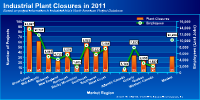 Click on image at right for a summary of 2011 industrial plant closures and lost jobs by region.
The continued high rate of industrial plant closures has hurt efforts to improve the unemployment rates of the United States, Canada and Mexico. In 2011, plants closed that employed in excess of 87,000 workers--jobs that will need to be replaced before any positive steps could be taken to lower the national unemployment rates in the three countries. The 76 plants that are currently scheduled to close in 2012 emply more than 22,000 workers, meaning companies will have to find more creative ways to add jobs in order to lower the unemployment rates.
The U.S. accounted for 430 of the industrial plants that closed in 2011 and was responsible for over 63,000 jobs lost as a result. Canada weighed in with another 79 plant closings and 13,800 jobs lost, while Mexico added a dozen plants and more than 2,500 lost jobs. In 2012, a similar pattern is emerging already. The U.S. currently has another 72 plants scheduled to close, which will result in 19,000 workers seeking new jobs. while Canada is looking at four plant closures scheduled for the coming months, which will result in another 2,700 lost jobs. At of this time, Mexico has no plant closures scheduled, but this is very likely to change in the coming weeks.
In the U.S., the Great Lakes and Mid-Atlantic regions were hammered with plant closings in 2011. The Great Lakes region saw 91 plants close and lost 13,500 jobs as a result, while the Mid-Atlantic region closed another 61 plants and put 11,700 workers on the unemployment rolls. In Canada, Ontario saw the largest number of closures in 2011, 33, which resulted in 7,800 jobs being lost, while Quebec contributed 23 closed plants and 2,900 newly unemployed people to the total. Looking at 2012's scheduled closures, the Great Lakes region is getting off to a good start on closures once again, with 14 currently scheduled that will result in 6,500 lost jobs. The Northeast region is looking at 11 plant closures in the coming months, which will see 4,800 people out of work, and the Southwest region will add another 10 plants to the total, resulting in 2,200 lost jobs.
In both 2011 and 2012, the Industrial Manufacturing Industry is leading the way with the largest number of plant closures. This is not entirely surprising, given the multitude of sectors that make up this industry and the reorganization that has gone on in recent years thanks to the recession. The Industrial Manufacturing Industry alone accounted for 190 of the plant closures in 2011, costing more than 43,000 jobs. In 2012, the industry is already scheduled to close an additional 34 plants, which will reduce the workforce by another 10,000 people. The Food & Beverage Industry has been another industry that has closed a large number of facilities. In 2011, the Food & Beverage Industry closed 100 plants, resulting in 12,600 jobs lost, although in 2012 there is only one facility scheduled to close at this point in time, which will cost another 800 jobs.
The Pulp, Paper & Wood Industry was also a significant contributor in 2011 closures, with 59 plants closed and 10,000 jobs lost. The Metals & Minerals Industry saw 63 plants close and 7,500 jobs lost. The Pharmaceutical & Biotech Industry added another 48 plant closures in 2011, which resulted in more than 14,600 jobs lost, and the Chemical Processing Industry added 38 plant closures and 5,500 jobs lost. Virtually every industry saw at least some closure activity in 2011, and they are all likely to see more in 2012.
Consolidation has been the name of the game over the last several years as companies have been working hard to control costs and streamline their operations. The increased number of plant closures will likely continue through 2012, although with some luck the final tally will not be as heavy once the year is completed. To counter this trend of closing industrial plants, spending has been on the rise once again and more project activity is occurring each year. If the economy remains at least partially healthy, industry should be able to keep up with the lost jobs despite the additional thousands of jobs that will be lost this year due to closures, but the closure toll is going to be a heavy once again this year if the early numbers are any indication of how things will go in 2012.
Industrial Info Resources (IIR), with world headquarters in Sugar Land, Texas, is the leading provider of global market intelligence specializing in the industrial process, heavy manufacturing and energy markets. IIR's quality-assurance philosophy, the Living Forward Reporting Principle, provides up-to-the-minute intelligence on what's happening now, while constantly keeping track of future opportunities.
/news/article.jsp
false
Want More IIR News Intelligence?
Make us a Preferred Source on Google to see more of us when you search.
Add Us On GoogleAsk Us
Have a question for our staff?
Submit a question and one of our experts will be happy to assist you.

Forecasts & Analytical Solutions
Where global project and asset data meets advanced analytics for smarter market sizing and forecasting.
Explore Our Solutions
Industrial Project Opportunity Database and Project Leads
Get access to verified capital and maintenance project leads to power your growth.
Discover Our DatabaseIndustry Intel
-
2026-2027 Investment Radar for Mexico, Central America & the CaribbeanPodcast Episode / May 29, 2026
-
Innovations Shaping the Next Era of Power GenerationPodcast Episode / May 22, 2026
-
The Role of Contract Manufacturing in Global Pharma GrowthPodcast Episode / May 8, 2026
-
2026 North American Labor OutlookPodcast Episode / Apr 24, 2026
-
2026 European Metals & Minerals Project Spending OutlookPodcast Episode / Apr 7, 2026