Production
IIR RGMI Insights: Weekly Wrap Up & the EIA Weekly #'s with Fundamental Analytics
Hope all are well in these tumultuous times as Russia's invasion of Ukraine enters its third week; where the overall outcome remains murky and will not be fully understood for some time yet.
Released Friday, March 11, 2022

Researched by Industrial Info Resources (Sugar Land, Texas)--Hope all are well in these tumultuous times as Russia's invasion of Ukraine enters its third week; where the overall outcome remains murky and will not be fully understood for some time yet.
Aljazeera: Timeline: Week two of Russia's invasion of Ukraine
A United States ban on Russian oil imports, failed ceasefires and more than two million refugees mark the second week of war in Ukraine.
Ukrainian officials have accused Russian forces of hitting a hospital complex in the besieged southeastern port city of Mariupol, as Russia's invasion of Ukraine continues amid growing international pressure on President Vladimir Putin to end the war. Ukraine's President Volodymyr Zelenskyy denounced the incident on Wednesday as an "atrocity" and reiterated a call for Kyiv's allies to impose a no-fly zone over the country -- a demand that has been rejected by the United States, the United Kingdom and NATO. As the war enters its third week, ongoing fighting has hampered efforts to evacuate civilians in hard-hit Ukrainian cities through humanitarian corridors. The United Nations has said more than two million people have fled the country since Russia's all-out invasion began on February 24.
Mr. WTI Oil Market has been quite volatile of late -- no surprise -- and has risen to ~$130 before coming off of late back less than $110.
Although Dan Graeber writing below for the Houston Chronicle mentions that estimates for crude prices remain high -- ranging from $150 to yes even $300.
Houston Chronicle: What you should know about Russian oil, Biden's import ban and how much you'll pay for gasoline
U.S. President Joe Biden on Tuesday signed an executive order that prohibits imports of Russian crude oil, among other products. While the United States buys a relatively small amount of fossil fuels, the ban will affect global markets.
"Today I'm announcing the United States is targeting the main artery of Russia's economy," the president said. "We're banning all imports of Russian oil and gas and energy." Replacing the Russian oil is not expected to be easy. OPEC is not ramping up production to make up the shortfall, and U.S. shale drillers are still moving cautiously. The United States and its allies are releasing 60 million barrels of oil from strategic reserves, but that's just a drop in the bucket in a global economy that consumes 100 million barrels of oil a day.
What will Biden's importation ban do?
Biden's plan takes immediate effect, but provides a 45-day cushion for companies to wind down existing contracts. The executive order bans the importation of "crude oil; petroleum; petroleum fuels, oils, and products of their distillation; liquefied natural gas; coal; and coal products." New investments in the Russian energy sector are also prohibited.
... Estimates for prices are staggering, ranging anywhere from $150 to $300 per barrel. The U.S. Energy Department, with the obvious caveats of uncertainty, said in its latest outlook that it expected the international benchmark Brent crude, which is trading at about $3 per barrel more than West Texas Intermediate, to average $116 per barrel during the second quarter, but moderate to $89 per barrel by next year.
IIR Energy's RGMI -- Refining Intel Answers can help to make sense of who with which grade of crude might replace the Russian barrels going into US Refineries -- from a relative value perspective.
As Refining Intel Answers leverages IIR Energy's Alliance Partner Refinitiv waterborne flows intelligence into their geocentric (vessel to port to refinery) crude allocation model to determine an initial refinery crude diet.
The world is still trying to make sense and understand how all of the sanctions imposed on Russia will affect the global economy as an 'economic war' is taking shape.
New York Times: 'Economic War'
...Combined, the sanctions -- by Britain, the U.S., the E.U. and others -- have been more aggressive than many analysts expected. "We're in totally new territory," Nicholas Mulder, a historian of sanctions, told The Atlantic. "The speed, the sweep and the size of the sanctions, or the size of the targets of the sanctions -- those three factors make them extraordinary."
The sanctions are unlikely to alter Putin's military strategy, at least in the short term: Russia seems committed to taking over Ukraine, almost regardless of the human cost. The Russian military has stepped up aerial bombardments across Ukraine, and has continued to attack civilians in an attempt to demoralize the population.
But the sanctions do have the potential to create longer-term problems for Putin's regime. A Kremlin spokesman has described them as "economic war." Among their effects:
- They have cut off Russian banks from large parts of the international financial markets, which in turn will make it harder for Russian families and businesses to take out loans, use credit cards and make purchases.
- The list of Western companies that are pulling out of Russia -- like McDonald's and Starbucks -- yesterday grew to include Goldman Sachs, JPMorgan Chase and Uniqlo. These shutdowns will reduce economic growth in Russia and may cause public frustration.
- Some companies have stopped exporting goods to Russia, which will complicate the manufacturing and sale of cellphones, cars and other technology-heavy items.
USA Today: Will there be a recession in 2022? The odds are rising amid soaring inflation, high energy prices
The U.S. economy is still climbing out of the COVID-19-induced downturn as a robust job market powers it to cruising speed.
So why is talk of recession in the air?
Some top economists are raising the odds of a slump within the next year or so amid Russia's invasion of Ukraine, rising energy prices, historic inflation, the stock market sell-off and the prospect of aggressive Fed rate hikes.
In IIR's Crude & Products Market Scorecard earlier this week, I spoke to the world being at a crossroads...
At the Crossroads we now find ourselves in these tumultuous times. As Russia appears to be a "no show" at the UN talks and seems to only desire a single outcome, "Ukranian surrender and capitulation to Mother Russia" - though from Ukraine "a surrender is off the table." So a crossroads. What will the eventual end game be? An already tight energy market gets tighter with no relief in sight. Might we see $150+ oil? It's likely. And inflation turns to hyperinflation, which could drive the global economy into a recession later this year. Western Nations themselves stand at these crossroads - Do they dare sanction Russian energy exports? For there is talk of the U.S. & Europe banning the Russian barrel but what will replace such at relative value especially in Europe? And ESG and the Energy Transition seems to be at a crossroads as well for what is unfolding in Eastern Europe could accelerate energy transformation toward alternative technologies, where China seems to hold many of the proverbial cards. What we know is this first full week of March will be a challenging and difficult one at these Crossroads with the world singing the blues...
And we understand -- with the US Administration posed ban on Russian crude -- that conversations have started with nations to see who could bring more barrels to the market.
Wall Street Journal: Ukraine War Pushes Biden Toward Venezuela, Iran and Saudi Arabia in Oil Hunt
Rush to offset Russia's rapidly shrinking energy exports has led the White House to oil-rich nations in the Middle East and countries under U.S. sanctions
The war in Ukraine has added urgency to the Biden administration's monthslong search for new oil supplies, as it seeks to contain surging energy prices through talks at home and diplomacy abroad with friends and foes alike.
The rush to fill gaps from Russia's rapidly shrinking contribution to the global energy markets has led the White House to oil-rich nations in the Middle East, countries under U.S. sanctions and private-sector oil giants meeting this week in Houston. But the quest has been complicated by several factors, including President Biden's vow to take a tougher line against Saudi Arabia over human-rights abuses, domestic political pressure and post-pandemic supply-chain disruptions.
With countries committing to release crudes from their Strategic Petroleum Reserves?
DOE: U.S. and 30 Countries Commit to Release 60 Million Barrels of Oil From Strategic Reserves to Stabilize Global Energy Markets
Today, U.S. Secretary of Energy Jennifer M. Granholm released this statement following an emergency meeting of the International Energy Agency (IEA) member countries in response to Russia's invasion of Ukraine:
"Today, I chaired an emergency ministerial meeting of the International Energy Agency (IEA) -- founded 50 years ago by the U.S. and other allies -- where the United States and 30 other member countries, supported by the European Commission, agreed to collectively release an initial 60 million barrels of oil from strategic petroleum reserves (SPRs). This decision reflects our common commitment to address significant market and supply disruptions related to President Putin's war on Ukraine. "In line with this decision, President Biden authorized me to make an initial commitment on behalf of the United States of 30 million barrels of oil to be released from the Strategic Petroleum Reserve. We stand prepared to take additional measures if conditions warrant.
Speaking of SPR -- Stateside SPR inventories are being reported at a roughly 20-year low, and crude inventories again surprise analyst expectations
Reuters: U.S. crude oil, fuel stockpiles fall last week, SPR at 2002 low
U.S. oil stockpiles fell across the board last week, the Energy Information Administration said on Wednesday, at the same time the energy market contends with worries of globally tight supply after Russia's invasion of Ukraine. Crude inventories fell by 1.9 million barrels in the week to March 4 to 411.6 million barrels, compared with analysts' expectations in a Reuters poll for a 657,000-barrel drop.
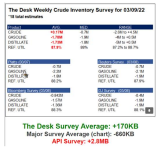
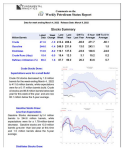 Click on the images at right for a look at crude oil inventory surveys and the U.S. Energy Information Administration's weekly petroleum status report for the week ending March 4.
Russia's invasion of Ukraine led to sharply higher crude oil prices earlier this week, but despite President Biden's decision to ban imports of Russian oil, prices were trending downward at mid-day Wednesday from their peaks earlier in the week. Still, crude's sharp price increases, even before the war began, led the Energy Information Administration to dramatically increase its average estimate of West Texas Intermediate prices for 2022, to an annual average of $101.77 per barrel this year, up $33 per barrel over 2021 average prices. The agency expects WTI crude to fall to an average of about $85 per barrel in 2023. Sharply higher prices for crude could pinch refiners' margins. The ban on Russian crude oil imports will force some US refiners to find alternate sources to replace lost Russian crude. Last week OPEC+ ministers, including the Russian representative, voted to continue the group's gradual increase in monthly production of about 400,000 bpd. Retail gasoline prices hit a national average of about $4.17 per gallon, up over 50 cents per gallon since the start of the Russian invasion of Ukraine. Against this backdrop, US crude oil inventories fell 1.9 million barrels to 411.6 million barrels for the week ended March 4, the DOE reported.
As the world has been thrown into turmoil with Russia's invasion of Ukraine there are glimmers of a compromise emerging which will enable the world to come to grips with the aftermath of such... Reuters: Analysis: Two weeks into Ukraine war, analysts detect faint glimmers of compromise emerge
Talks between the Russian and Ukrainian foreign ministers produced no apparent progress towards a ceasefire on Thursday but analysts said the fact they were even meeting left a window open for ending Russia's war against Ukraine.
Ukraine's Dmytro Kuleba said his Russian counterpart Sergei Lavrov had indicated he did not have the authority to negotiate even a 24-hour ceasefire or a humanitarian corridor in Mariupol, the besieged southern Ukrainian city under heavy fire from Russian artillery.
Your feedback is very important to us. Please let us know if we may provide additional color or answer any other market questions you may have.
Additional IIR Resources:
- IIR Team Email: iirteam@iirenergy.com.
- enelyst oil markets IIR Crude Runs chat
- Latest IIR Crude & Products Market Scorecard
- Latest IIR PCGMI Weekly update video newscast
Ask us! We have answers!!
Industrial Info Resources (IIR), with global headquarters in Sugar Land, Texas, six offices in North America and 12 international offices, is the leading provider of global market intelligence specializing in the industrial process, heavy manufacturing and energy markets. Industrial Info's quality-assurance philosophy, the Living Forward Reporting Principle, provides up-to-the-minute intelligence on what's happening now, while constantly keeping track of future opportunities. Follow IIR on LinkedIn.
/news/article.jsp
false
Want More IIR News Intelligence?
Make us a Preferred Source on Google to see more of us when you search.
Add Us On GoogleAsk Us
Have a question for our staff?
Submit a question and one of our experts will be happy to assist you.

Forecasts & Analytical Solutions
Where global project and asset data meets advanced analytics for smarter market sizing and forecasting.
Explore Our SolutionsRelated Articles
-
Both Coasts of Canada Enjoying Energy Sector SuccessJune 22, 2026
-
Canada Set New Record in Crude Oil Production in 2025June 19, 2026

PECWeb Global Market Intelligence Platform
Identify opportunities, anticipate change, and execute with confidence. PECWeb connects the industrial intelligence you need, from projects and assets to operational events, all in one platform.
Discover PecwebIndustry Intel
-
Brazil: Efficiency, Innovation, and Opportunities in the Food & Beverage IndustryPodcast Episode / Jun 12, 2026
-
2026-2027 Investment Radar for Mexico, Central America & the CaribbeanPodcast Episode / May 29, 2026
-
Innovations Shaping the Next Era of Power GenerationPodcast Episode / May 22, 2026
-
The Role of Contract Manufacturing in Global Pharma GrowthPodcast Episode / May 8, 2026
-
2026 North American Labor OutlookPodcast Episode / Apr 24, 2026