Power
Deloitte: AI Could Help Power Industry Solve Challenges in 2024
2024 will not simply be an extension of 2023. New pressures will affect the velocity and trajectory of industry's transformation
Released Wednesday, February 07, 2024

Written by John Egan for Industrial Info Resources (Sugar Land, Texas)--The strategic forces that drove the U.S. Power Industry in 2023 likely will continue shaping that industry this year, according to a recent report from consultants Deloitte (London, England). "In 2023, the U.S. power and utilities industry raised the decarbonization bar, deployed record-breaking volumes of solar power and energy storage, and boosted grid reliability and flexibility--with a healthy assist from landmark clean-energy and climate legislation," said the recent report, 2024 Power and Utilities Industry Outlook. All those trends likely will continue unfolding in 2024, it added.
But 2024 will not simply be an extension of 2023. New pressures will affect the velocity and trajectory of the industry's transformation, added the report's authors, Jim Thompson, vice chair, U.S. Power, Utilities & Renewables; Kate Hardin, executive director of Deloitte's Research Center for Energy and Industrials; and Suzanna Sanborn, senior manager in the Deloitte Center for Energy Solutions.
The authors note that supply chain knots "began to unwind" in 2023, but are not yet fully untied, as shortages of steel, aluminum, transformers and other components and materials continue to be the rule, not the exception. The largest companies in the electricity business had record-high capital expenditures (capex) of almost $171 billion in 2023 to modernize and decarbonize the grid. That, also, was not a one-time thing. Though the authors don't hazard a guess as to the industry's 2024 capital investments, it noted that the industry faces "robust future spending requirements."
Other forces driving up utility spending in 2024 and beyond will be a mix of capex and operational expenditures (opex): "Mounting costs for weather and climate disaster recovery, wildfire prevention, and cyber and physical security programs," all of which will create upward pressure on retail electricity prices.
But regulators are pushing back on utility price increases, citing affordability concerns. This has caused some utilities to sell some peripheral assets or seek a capital infusion from large infrastructure investment firms to pay for some of their capital projects. For more on that, see January 16, 2024, article - Moody's Report Details Scope of Power Industry's Capital Programs Over 2024-2028 Period.
In the U.S., Industrial Info is tracking about 4,420 electric-utility capital projects scheduled to kick off in the five-year period from 2024 through 2028. The value of those projects is about $879 billion.
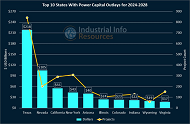 Click on the image at right to see a chart of the top 10 state markets, ranked by the dollar-value of proposed Electric Power projects.
Momentum for the clean-energy transition will continue to accelerate in 2024, building on the last year's drivers, Deloitte said in its 2024 Power and Utilities Industry Outlook, which was published December 5:
- A growing group of U.S. electric companies has committed to cut carbon emissions by 80% by 2030--pulling deadlines forward from the "net-zero by 2050" goal many had announced previously.
- By the Inflation Reduction Act's (IRA) first-year anniversary in August 2023, investors had planned at least $122 billion of investment in clean-energy generation projects and more than $110 billion in new clean-energy manufacturing to develop domestic supply chains. The pace is not slowing.
- Billions of dollars were awarded under the Infrastructure Investment and Jobs Act (IIJA) in 2023 for grid reliability and resiliency, battery supply-chain development, electric vehicle (EV) programs and energy efficiency. More is on the way in 2024.
- The U.S. Energy Information Administration (EIA) expects 2023 utility-scale solar installations to more than double year-over-year deployments to a record-breaking 24 gigawatts (GW), with another 36 GW in 2024. The agency projected that renewables' share of electricity will rise from 22% in 2023 to nearly 25% in 2024.
- Cumulative U.S. grid-scale battery-storage capacity roughly doubled in 2023 to about 18 GW, and could likely reach 32 GW in 2024, adding crucial flexibility to help manage renewable variability.
- EVs accounted for 9% of new cars sold in the first three quarters of 2023 and likely will hit the milestone of 1 million cars sold per year for the first time by year-end. Some models have reached price parity with gasoline-powered cars, which some studies suggest could portend mass adoption.
- Power and utilities companies will likely turn increasingly to artificial intelligence and other digital solutions in 2024 to address the massive challenges they face in transforming the grid.
- Electrification: The Power Industry is preparing for as much as a tripling of U.S. electricity demand within the next couple of decades, the Deloitte report predicted: "Electrification of the transportation, building and industrial segments continues to pick up speed in many parts of the country. At the same time, growth of data centers using energy-intensive applications such as AI [artificial intelligence] is expected to further boost demand." Some utilities in high EV adoption areas already have raised projections, with Southern California Edison, a unit of Edison International (NYSE:EIX) (Rosemead, California), increasing its estimated load growth by 2045 to 80% from 60%. More will likely follow in 2024 and beyond.
Click on the image at right to see the results of a Deloitte survey of power industry professionals as to their strategies for meeting potential generation shortfalls.
- Resource planning: A critical element of modernizing and decarbonizing the electric grid is addressing reliability risks, Deloitte said in its 2024 Power and Utilities Industry Outlook. Those risks are likely to continue evolving in 2024 as the electric power industry focuses on emerging resource adequacy solutions. The consultants said some of the approaches expected to gain traction in 2024 include harnessing distributed energy resources (DERs) in virtual power plants (VPPs), improving distribution system planning (DSP), and integrating DSP with bulk system planning or integrated resource planning (IRP).
- Climate: As this week's widespread flooding in California showed, the ravages of extreme weather--accentuated, many scientists say, by a changing climate--is not limited to a year or a geographic region. "Extreme heat and drought conditions will likely continue to disrupt power sector operations in 2024," the report said, "but the industry may be inching toward less water-intensive power production over time." The summer of 2023 was one of the hottest on record, and forecasters expect this trend to continue. The Deloitte consultants note that the U.S. West is drier than it's been in 1,200 years, and researchers say the region is in a decades-long pattern of aridification and is likely to get hotter and drier. Droughts and extreme heat conditions can threaten to reduce generation from renewable resources, just when consumers are retreating inside to turn on their air conditioners.
- Capital planning: As power and utilities sector capital expenditures reach new heights and continue to rise well into 2024, companies will keep trying to balance record-high investments with customer affordability. The Deloitte report noted that "utilities will likely continue to tap alternative sources to raise cash for their capital programs and keep customer bills affordable. These may include grants, loans, and tax credits from federal and state programs largely made available under the IIJA and the IRA; as well as operational savings; asset sales; and business model innovations." The IIJA allocated about $94 billion in electric sector spending while the IRA earmarked about $287 billion for clean energy projects, according to Deloitte's tally. Xcel Energy Incorporated (NASDAQ:XEL) (Minneapolis, Minnesota) is planning on federal tax credits to pay for up to $10 billion of its proposed $15 billion, clean-energy capital program in Colorado. For more on that, see September 25, 2023, article - Federal Tax Credits to Pay for Most of Xcel Energy's Proposed $15 Billion Clean Power Plan.
- Artificial intelligence: Generative AI could help address core power industry challenges by keeping costs low. The Deloitte report said the power sector "is on the verge of entering a transformative era, led by generative AI, a subset of AI that has the potential to eventually help address core power industry challenges." Generative AI, a technology that creates new content in the form of text, code, voice, images, videos and processes, can potentially help improve electric power industry reliability, affordability, efficiency, sustainability and health and safety. Power and utilities companies are embracing this innovation, with at least 16% of the top 25 utilities already in the initial stages of integrating generative AI into their operations, as indicated by quarterly earnings call transcripts. "In 2024 and beyond," it continued, "generative AI and other large language models (LLMs) are expected to expand the industry's capabilities to handle tasks such as complex data analysis, pattern recognition, forecasting, and optimization. This could help address some of the core issues they face around resource planning, grid management and cost reduction."
Answers to these challenges, Deloitte said in its 2024 Power and Utilities Industry Outlook, lies in emerging technologies, market innovations and policies.
AI could be one way to meet some of these challenges, the firm said: AI "could eventually enable the kind of real-time, holistic system planning that could add critical visibility and valuation capabilities across the grid as variable renewables and DERs proliferate and electricity demand potentially escalates."
Industrial Info Resources (IIR) is the leading provider of industrial market intelligence. Since 1983, IIR has provided comprehensive research, news and analysis on the industrial process, manufacturing and energy related industries. IIR's Global Market Intelligence (GMI) platform helps companies identify and pursue trends across multiple markets with access to real, qualified and validated plant and project opportunities. Across the world, IIR is tracking more than 200,000 current and future projects worth $17.8 trillion (USD).
/news/article.jsp
false
Want More IIR News Intelligence?
Make us a Preferred Source on Google to see more of us when you search.
Add Us On GoogleAsk Us
Have a question for our staff?
Submit a question and one of our experts will be happy to assist you.

Forecasts & Analytical Solutions
Where global project and asset data meets advanced analytics for smarter market sizing and forecasting.
Explore Our Solutions
Industrial Project Opportunity Database and Project Leads
Get access to verified capital and maintenance project leads to power your growth.
Discover Our DatabaseIndustry Intel
-
2026-2027 Investment Radar for Mexico, Central America & the CaribbeanPodcast Episode / May 29, 2026
-
Innovations Shaping the Next Era of Power GenerationPodcast Episode / May 22, 2026
-
The Role of Contract Manufacturing in Global Pharma GrowthPodcast Episode / May 8, 2026
-
2026 North American Labor OutlookPodcast Episode / Apr 24, 2026
-
2026 European Metals & Minerals Project Spending OutlookPodcast Episode / Apr 7, 2026