Production
Early U.S. Forecasts Signal Near-Normal Atlantic Hurricane Season
With less than 40 days until hurricane season, early U.S. forecasts point to a generally quieter Atlantic driven by El Niño.
Released Thursday, April 23, 2026

Written by Aaron Studwell, Ph.D., Energy Meteorologist & Analyst for IIR News Intelligence (Sugar Land, Texas)
Summary
With less than 40 days until hurricane season, early forecasts point to a generally quieter Atlantic driven by El Niño. However, warm ocean waters and one outlier outlook highlight ongoing uncertainty and continued risk for energy and industrial infrastructure.A Clear Divide
With less than 40 days remaining until the start of the Atlantic hurricane season, early forecasts are beginning to outline a developing narrative. While confidence remains limited at this time, a clear divide has emerged between most forecasts calling for a quieter season and the outlier maintaining the potential for more active conditions.According to Industrial Info Resources data, energy and industrial infrastructure exposure across the Gulf Coast and Atlantic seaboard remains significant, regardless of anticipated seasonal totals. This perspective reinforces that even a near-normal or below-normal season can carry meaningful operational risk.
Hurricanes can greatly impact offshore oil and gas production. Industrial Info Resources is tracking 83 active capital offshore Oil & Gas Production projects in the U.S. Gulf of Mexico, worth US$43.62 billion. Subscribers to the Industrial Info Resources Global Market Intelligence (GMI) Project Database can view a list of detailed project reports.
Below-Normal Signals Driven by Expectations of a Strong El Niño
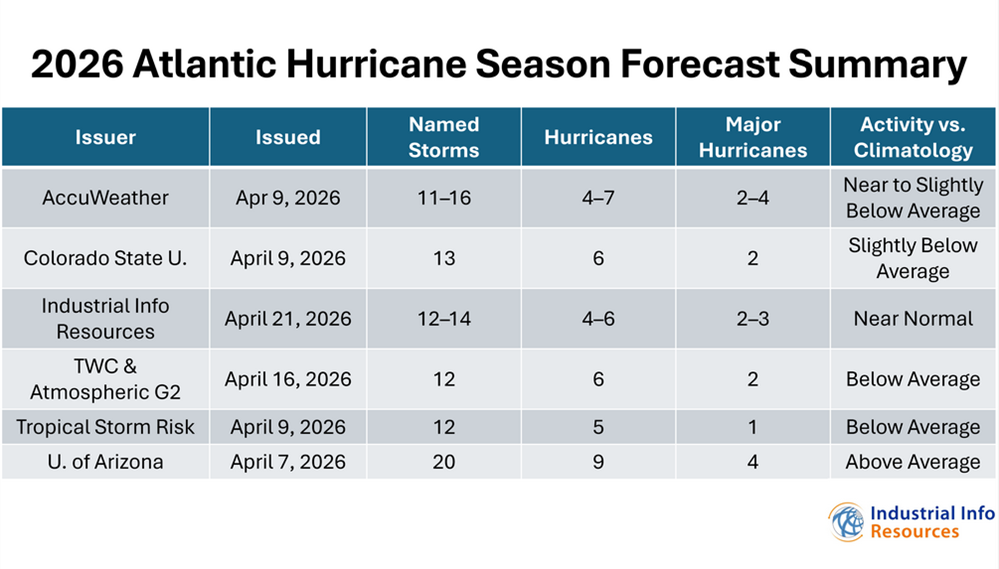
Several leading forecasts are aligned around a common theme: the increasing likelihood of El Niño development during the peak of hurricane season. This includes outlooks from Colorado State University, Tropical Storm Risk, and The Weather Company, all of which point to below-average activity.Colorado State University's April outlook calls for 13 named storms, 6 hurricanes and 2 major hurricanes, slightly below the long-term average. Similarly, Tropical Storm Risk sees a more suppressed season with 12 named storms, 5 hurricanes and just 1 major hurricane, reflecting a stronger emphasis on atmospheric suppression. Major hurricanes are defined storms that has maximum sustained winds of 111 miles per hour or greater; Category 3 on the Saffir-Simpson Scale.
The Weather Company's Atmospheric G2 forecast falls in a similar range, with 12 named storms, 6 hurricanes and 2 major hurricanes. Its analysis highlights a key difference from recent active seasons, noting that Atlantic sea surface temperatures are not as anomalously or uniformly warm as in 2023. This will limit the basin's ability to offset El Niño-driven wind shear.
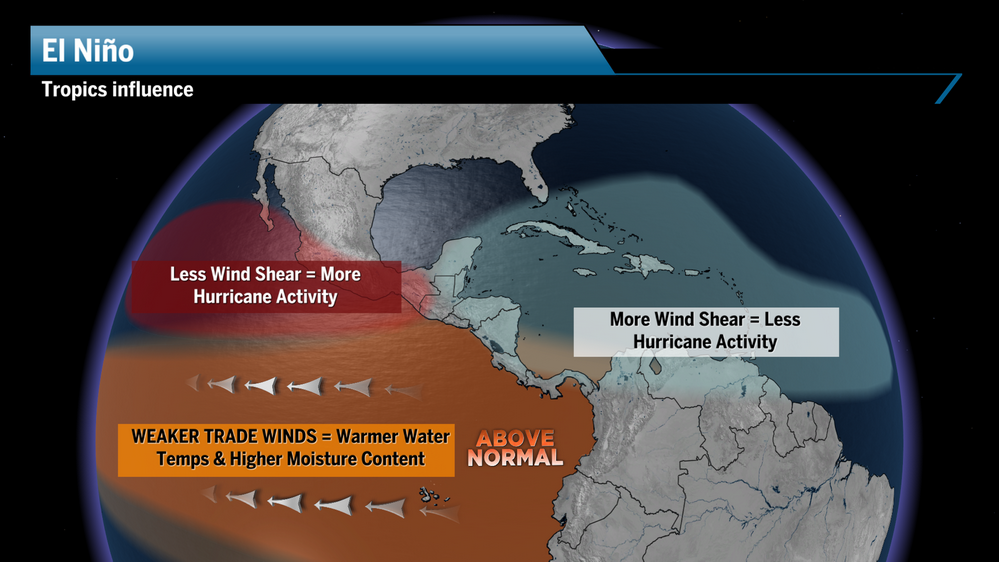
Across these forecasts, the primary driver is consistent: strengthening upper-level winds and increased atmospheric stability associated with El Niño are expected to disrupt storm development, particularly during the August-through-October peak.
Typical influence of El Niño on Pacific and Atlantic seasonal hurricane activity. Adapted from Climate.gov, based on originals by Gerry Bell.
Broader Range from AccuWeather
AccuWeather's outlook offers a wider range of possible outcomes. AccuWeather projects 11 to 16 named storms, 4 to 7 hurricanes and 2 to 4 major hurricanes. This forecast spans from near-normal to slightly below-normal conditions.This broader range reflects a greater uncertainty around how strong the El Niño will develop and how effectively it will suppress Atlantic activity. AccuWeather also emphasizes that warm ocean waters, particularly in the western Atlantic and Gulf of Mexico, may still support rapid intensification events.
Notably, AccuWeather highlights an elevated risk for direct U.S. impacts, particularly along the northern and northeastern Gulf Coast and the Carolinas. This reinforces a key operational point: lower storm counts do not necessarily translate to lower landfall risk.
Outlier Forecast from out West
Not all forecasts are aligned toward suppression. The University of Arizona stands out as an early outlier, projecting a well-above-average season with 20 named storms, 9 hurricanes and 4 major hurricanes.This outlook places greater weight on persistent Atlantic warmth and analog years that support higher activity. It also reflects a lower confidence in El Niño becoming strong enough to significantly suppress storm development.
While currently in the minority, this forecast highlights the underlying uncertainty in early-season outlooks and the potential for conditions to evolve toward a more active regime if atmospheric suppression fails to materialize.
IIR Outlook: Near-Normal Season with Competing Signals
The Industrial Info Resources seasonal outlook currently calls for a near-normal Atlantic hurricane season, reflecting the balance between competing atmospheric and oceanic signals.The combined output from statistical and dynamical model guidance points toward El Niño development during the April-June period, with probabilities near 70%. Beyond early summer, El Niño becomes the overwhelmingly favored outcome, with probabilities increasing to between 88% and 92% from May to June through September-November. The forecast outlook signals strong confidence that El Niño conditions will dominate through the Atlantic hurricane season.
At the same time, Atlantic sea surface temperatures are expected to remain above normal, particularly early in the season. This raises the potential for early tropical development before wind shear becomes more dominant later in the summer.
As the hurricane season approaches its climatological peak in early September, Atlantic sea surface temperatures are forecast to slowly approach normal levels. This is particularly notable in the eastern and central Atlantic. It is noteworthy that the Gulf and Caribbean Sea will stay warmer, allowing for potential tropical development in these regions.
The Industrial Info Resources' seasonal tropical outlook for the Atlantic basin is:
- 12-14 named storms;
- 4-6 hurricanes; and
- 2-3 major hurricanes.
Ultimately, the current forecast landscape reflects a classic setup: a tug-of-war between atmospheric suppression and oceanic support. Even within a near-normal framework, the risk profile remains elevated for energy and industrial markets, where a single landfalling storm or slow-moving rainfall event can drive outsized impacts.
- Most early forecasts call for a near- to below-normal season, driven by expected El Niño development.
- Increased wind shear during the peak season (August-October) is forecast to be the primary suppressing factor.
- Atlantic sea surface temperatures remain warm enough to support early-season activity and potential rapid intensification.
About Industrial Info Resources
Industrial Info Resources (IIR) is the leading provider of industrial market intelligence. Since 1983, IIR has provided comprehensive research, news and analysis on the industrial process, manufacturing and energy related industries. IIR's Global Market Intelligence (GMI) helps companies identify and pursue trends across multiple markets with access to real, qualified and validated plant and project opportunities. Across the world, Industrial Info Resources is tracking over 250,000 current and future projects worth $30.2 Trillion (USD).
/news/article.jsp
false
Want More IIR News Intelligence?
Make us a Preferred Source on Google to see more of us when you search.
Add Us On GoogleAsk Us
Have a question for our staff?
Submit a question and one of our experts will be happy to assist you.

Forecasts & Analytical Solutions
Where global project and asset data meets advanced analytics for smarter market sizing and forecasting.
Explore Our SolutionsRelated Articles
-
Enbridge Joint Venture to Fund Westcoast NatGas Pipeline Exp...August 28, 2026
-
Fracker Could Help U.S. Data Centers Overcome Strategic Chal...August 28, 2026
-
El Niño Shapes North America Fall, Winter OutlookAugust 27, 2026

PECWeb Global Market Intelligence Platform
Identify opportunities, anticipate change, and execute with confidence. PECWeb connects the industrial intelligence you need, from projects and assets to operational events, all in one platform.
Discover PecwebIndustry Intel
-
European Chemicals and Transport Fuels OutlookPodcast Episode / Jul 10, 2026
-
2026 European Petroleum Refining Project OutlookPodcast Episode / Jun 26, 2026
-
Brazil: Efficiency, Innovation, and Opportunities in the Food & Beverage IndustryPodcast Episode / Jun 12, 2026
-
2026-2027 Investment Radar for Mexico, Central America & the CaribbeanPodcast Episode / May 29, 2026
-
Innovations Shaping the Next Era of Power GenerationPodcast Episode / May 22, 2026