Production
Efficiencies Keep U.S. Oil Production Elevated
The U.S. federal government now says it's well efficiency that matters when making projections
Released Wednesday, March 06, 2024
Written by Daniel Graeber for Industrial Info Resources (Sugar Land, Texas)--Before the pandemic, rig counts were used as a barometer to gauge U.S. crude oil production trends. But the federal government now says it's well efficiency that matters when making projections.
The Baker Hughes rig count was among the most closely watched data points on any given week, as the number of rigs in a particular basin became associated with production trends. During the latter half of the previous decade, analysts would comb over everything from drilled, but uncompleted (DUC) wells to general trends internationally.
But rig counts are on the decline, though not to the detriment of output. In 2018, U.S. crude oil production averaged 10.8 million barrels per day (BBL/d), according to the U.S. Energy Information Administration (EIA). In the EIA's latest forecast, data show that total crude oil production averaged 13.3 million BBL/d, and it's not because of rig counts.
"Recently, U.S. crude oil production has increased because of technological advancements and efficiency gains, despite a 69% decrease in the number of active rigs since 2014," the EIA's analysts wrote.
Simply put, new wells are more efficient. The EIA points to two data sets: new well production, defined as oil extracted during the first 12 months of production; and legacy production, the amount of oil that's been extracted after the initial 12 months.
Since 2021, EIA data show, legacy production has remained stable, while new-well production has increased. The latest data from the Permian Basin, the most abundant inland oil producer in the U.S., confirms a general trend upward in new-well oil production per rig and a general, but slow, decline in legacy production, discarding some of the volatility during the COVID-19 pandemic.
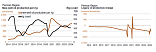 Click on the image at right for graphs detailing data from the EIA's February Drilling Productivity Report.
Efficiencies emerged in the form of multi-lateral wells, which The American Oil & Gas Reporter said would "revolutionize" shale development. Those laterals, meanwhile, are extending longer and longer, reaching nearly three miles in the horizontal direction, and at increasingly lower costs.
Those methods are paying off. Before 2014, total Permian production struggled to flirt with 3 million BBL/d. The latest Drilling Productivity Report shows Permian oil production should be close to 6.1 million BBL/d, an increase of 103% over the course of a decade.
This follows concerns that U.S. oil production is on the decline, though longer laterals and well efficiency should keep the shale-rich nation at the top of the production heap for the time being.
EIA data show the U.S. became the global leader in crude oil production in 2018, passing both Russia and Saudi Arabia with an annual average that year of 10.8 million BBL/d. By now, the U.S. accounts for about 15% of total global crude oil production.
Not only that, but the end of a moratorium on crude oil exports in 2015 helped establish the U.S. as a global player, which carries geopolitical ramifications given the Western pressure on producers such as Iran, Russia and Venezuela. With barrels at a premium because of global conflict, importers are relying more on countries like the U.S.
"After lifting the crude oil export ban at the end of 2015, the country has turned into a net exporter," wrote Tamas Varga, an analyst at London oil broker PVM. "In 2015, the U.S. demanded more than 5 million BBL/d of foreign crude oil and products to satisfy its thirst, but last year they sent nearly 2 million BBL/d overseas on a net basis."
Total U.S. crude oil production averaged 12.9 million BBL/d in 2023 and 13.1 million BBL/d this year, and it is forecast to reach 13.49 million BBL/d in 2025, another record in the EIA's data.
Industrial Info Resources (IIR) is the leading provider of industrial market intelligence. Since 1983, IIR has provided comprehensive research, news and analysis on the industrial process, manufacturing and energy related industries. IIR's Global Market Intelligence (GMI) platform helps companies identify and pursue trends across multiple markets with access to real, qualified and validated plant and project opportunities. Across the world, IIR is tracking more than 200,000 current and future projects worth $17.8 trillion (USD).
/news/article.jsp
false
Want More IIR News Intelligence?
Make us a Preferred Source on Google to see more of us when you search.
Add Us On GoogleAsk Us
Have a question for our staff?
Submit a question and one of our experts will be happy to assist you.

Forecasts & Analytical Solutions
Where global project and asset data meets advanced analytics for smarter market sizing and forecasting.
Explore Our SolutionsRelated Articles
-
Canadian Energy Trade Still Tied to U.S. EconomyMay 29, 2026
-
Canada's Ksi Lisims LNG a Slam Dunk, Premier SaysMay 28, 2026

Industrial Project Opportunity Database and Project Leads
Get access to verified capital and maintenance project leads to power your growth.
Discover Our DatabaseIndustry Intel
-
2026-2027 Investment Radar for Mexico, Central America & the CaribbeanPodcast Episode / May 29, 2026
-
Innovations Shaping the Next Era of Power GenerationPodcast Episode / May 22, 2026
-
The Role of Contract Manufacturing in Global Pharma GrowthPodcast Episode / May 8, 2026
-
2026 North American Labor OutlookPodcast Episode / Apr 24, 2026
-
2026 European Metals & Minerals Project Spending OutlookPodcast Episode / Apr 7, 2026