Metals & Minerals
Falling Coal Use Hits Adjacent Industries, State Budgets
U.S. utilities continue to reduce their use of coal to generate electricity, and the results are starting to be felt in adjacent industries, such as railroads and coal-mining companies
Released Tuesday, May 14, 2024

Written by John Egan for Industrial Info Resources (Sugar Land, Texas)--U.S. utilities continue to reduce their use of coal to generate electricity, and the results are starting to be felt in adjacent industries, such as railroads and coal-mining companies--and in the state capital of Wyoming, where an economy built around the black rock is scrambling to find alternative sources of revenue.
Squeezed by environmental regulations and low-priced natural gas, electricity generated from coal in the Lower 48 states fell about 23% between 2021 and 2023, according to the U.S. Energy Information Administration (EIA), the statistical and analytic branch of the Department of Energy (DOE) (Washington, D.C.).
Separately, the EIA said thermal coal use by U.S. electric generators fell about 18% in 2023, to about 387 million short tons from 472 million short tons in 2022. The EIA forecast coal usage by electric generators will continue falling, to an estimated 373 million short tons in 2024 and 346 million short tons in 2025.
Since peaking at slightly more than 1 billion short tons in 2008, use of coal to generate electricity in the U.S. has fallen steadily. In 2008, more than 50% of domestic electricity was generated by burning coal, but natural gas and renewables have since overtaken King Coal as fuels to generate electricity.
Coal was used to generate about 16.2% of electricity in the U.S. last year, EIA said. By contrast, 43.1% of all U.S. power was generated from natural gas in 2023, while renewables, including hydropower, generated about 21.4%. Also surpassing coal was nuclear, which accounted for about 18.6% of power generated domestically in 2023, EIA said.
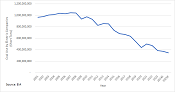 Click on the image at right to see a graph detailing the declining use of coal to generate electricity in the U.S.
Though some electricity providers, such as PacifiCorp (Portland, Oregon), expect to increase their use of coal in the coming years, those firms appear to be at outlier, at least for now. For more on PacifiCorp's plan to increase its use of coal, see April 10, 2024, article - PacifiCorp's New Plan: Use Coal Longer, Cut Renewables and Storage. More often, generators, such as the Tennessee Valley Authority (TVA) (Knoxville, Tennessee), continue to turn to gas and renewables at the expense of coal. For more on that, see April 9, 2024, article - TVA's Decarbonization Journey Continues with Decision to Transform Kingston Campus.
After bottoming out at 36,700 coal mine workers three years ago, the industry's employment has risen slightly, to about 44,100 last month, according to the Federal Reserve Bank of St. Louis. Employment in coal mines peaked four decades ago, at about 177,500.
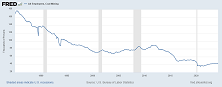 Click on the image at right to see a graph from the Federal Reserve Bank of St. Louis detailing U.S. coal-mine employment.
Over the decades, miners have been displaced by a combination of adverse environmental regulation and the increasing use of automation to extract coal.
Coal mining companies reported solid profits for full-year 2023, but the effect of declining coal sales is shown in the first-quarter 2024 earnings reports of those firms. First-quarter profits at Peabody Energy Corporation (NYSE:BTU) (St. Louis, Missouri) sank 79% compared to year-earlier results. CONSOL Energy Incorporated (NYSE:CEIX) (Canonsburg, Pennsylvania) said first-quarter profits fell about 56% compared to the year-earlier quarter. First-quarter profits fell about 17% for Alliance Resource Partners LP (NASDAQ:ARLP) (Tulsa, Oklahoma). Arch Resources Incorporated (NYSE:ARCH) (St. Louis), the nation's second largest coal producer, hinted at possible layoffs when it reported first-quarter earnings plummeted about 72%.
Coal companies had a far better year in 2023, when earnings, production and stock prices all rose, in some cases driven by exports to Asia of thermal and metallurgical coal, which is used in steelmaking. For more on that, see March 14, 2024, article - Fear, Uncertainty and Doubt--Coal Miners, Oil Producers Roll Out Time-Tested Strategy.
The railroad industry, which transports most of the nation's coal, also is feeling a downdraft from reduced coal use by generators. Union Pacific Corporation (NYSE:UNP) (Omaha, Nebraska) reported a 23% decline in freight revenue from shipments of coal and renewables, an 18% fall in revenue carloads from those shipments, and a 16% decrease in revenue ton-miles from those shipments, for the first quarter compared to 2023's first quarter.
In Wyoming, the nation's largest coal-producing state, production from the 12 mines in the Powder River Basin (PRB) fell 20% in the first quarter, a drop of roughly 12 million tons, to about 46 million short tons from 58 million short tons in the first quarter of 2023, according to a recent report from the Gilette News Record, citing data from the U.S. Labor Department's Mine Safety and Health Administration. In the fourth quarter of 2023, PRB production was about 57 million tons.
PRB's full-year coal production peaked in 2008 at about 446.5 million tons of coal mined in 2008, but annual production fell steadily over the 2014-2020 period, until it bottomed out at about 206.9 million tons in 2020, the Gilette News Record report said. It added that the low point hit in 2020 was followed by a two-year increase in production, but that ended in 2023 when production slid to about 230 million tons.
The Cowboy State is one of several Republican-led states that is expected to challenge the newly finalized suite of EPA rules targeting emissions from coal-fired power plants. For more on the finalized suite of rules, see April 26, 2024, article - EPA Issues Rules that Could Reshape Electric Generation.
Seeing the writing on the wall about coal, Wyoming has been trying to reposition itself, adding wind generation, interstate transmission projects and serving as the site for a next-generation nuclear power plant slated to be built on a soon-to-be-closed coal plant and mine in Kemmerer.
But the continued decline in PRB production, coupled with relatively low coal prices, has thrown a double whammy on the Wyoming budget, which is heavily reliant on extractive industries such as coal, oil and gas. State government revenue generated by minerals extraction is expected to fall about $11.6 million in the current fiscal year, and an additional $18.4 million in fiscal year 2025, according to an estimate from a group of state financial experts called the Consensus Revenue Estimating Group (CREG).
Industrial Info Resources (IIR) is the leading provider of industrial market intelligence. Since 1983, IIR has provided comprehensive research, news and analysis on the industrial process, manufacturing and energy related industries. IIR's Global Market Intelligence (GMI) platform helps companies identify and pursue trends across multiple markets with access to real, qualified and validated plant and project opportunities. Across the world, IIR is tracking more than 200,000 current and future projects worth $17.8 trillion (USD).
/news/article.jsp
false
Want More IIR News Intelligence?
Make us a Preferred Source on Google to see more of us when you search.
Add Us On GoogleAsk Us
Have a question for our staff?
Submit a question and one of our experts will be happy to assist you.

Forecasts & Analytical Solutions
Where global project and asset data meets advanced analytics for smarter market sizing and forecasting.
Explore Our SolutionsRelated Articles

Industrial Project Opportunity Database and Project Leads
Get access to verified capital and maintenance project leads to power your growth.
Discover Our DatabaseIndustry Intel
-
2026-2027 Investment Radar for Mexico, Central America & the CaribbeanPodcast Episode / May 29, 2026
-
Innovations Shaping the Next Era of Power GenerationPodcast Episode / May 22, 2026
-
The Role of Contract Manufacturing in Global Pharma GrowthPodcast Episode / May 8, 2026
-
2026 North American Labor OutlookPodcast Episode / Apr 24, 2026
-
2026 European Metals & Minerals Project Spending OutlookPodcast Episode / Apr 7, 2026