Metals & Minerals
Metals and Minerals in Brazil: Challenges and Opportunities
Brazil has consolidated itself as one of the most influential economies in Latin America and a key player in the global trade of raw materials
Released Monday, August 25, 2025
Written by Renzo Castillo for Industrial Info Resources (Sugar Land, Texas)--Brazil has consolidated itself as one of the most influential economies in Latin America and a key player in the global trade of raw materials. Within this structure, mining and steel production occupy a central place, both for their contribution to GDP and for their role in driving exports and strengthening Brazil's international competitiveness.
The weight of its metals and minerals industry positions Brazil as a key player in global supply chains, particularly for iron ore, an essential ingredient in the steel industry and one of the most demanded resources worldwide. This strength has allowed Brazil to position itself as a strategic partner for major economies that consume steel and are developing their infrastructure.
Amid the energy transition and the increasing demand for critical minerals, Brazil can further expand its international relevance. While maintaining its leadership in iron and steel, Brazil can project itself as a reliable supplier of new key raw materials--such as copper, nickel, lithium and rare earths--that are indispensable for the development of clean technologies and the transformation of productive systems worldwide.
According to information tracked by Industrial Info, the investment outlook in Brazil is solid and diverse. More than 1,000 active projects are being monitored in the metals and minerals industry, representing a total value of more than US$6.4 billion. Brazil also is home to more than 600 operational plants, reflecting the strength of its industrial infrastructure and the scale of the sector.
Within Latin America, Brazil trails only Chile in its investment volume, accounting for about 20% of the region's total market. This leadership is reinforced by a strong concentration of capital in three key states: Minas Gerais, Pará and Bahia.
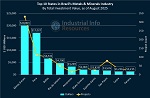 Click on the image at right for a graph detailing the top 10 states in Brazil for metals and minerals projects, by total investment value.
Minas Gerais, which holds 31% of Brazil's investments, is the historical heart of Brazilian mining. Pará, with 26%, has experienced a significant expansion in copper, gold and iron projects, while Bahia, representing 10% of the total, is gaining relevance with initiatives linked to various metals and, increasingly, lithium. Together, these three states account for more than 500 active projects, with investments exceeding US$4 billion, consolidating themselves as the main mining development hubs in Brazil.
Some of the most relevant projects include the:
- Ilhéus Iron Project, by Brazil Iron Trading, which aims to reinforce the country's position as a leading iron exporter
- Furnas Copper Project, a joint venture between Ero Copper and Vale, which aims to diversify production toward minerals with higher global demand
- Parauapebas Alemão Project, by Vale, which is focused on copper and gold production
Industrial Info is monitoring more than US$10 billion in steel-related projects across Brazil, including greenfield developments, expansions, technological modernization, and efficiency improvements.
The main export destinations for Brazilian steel are the U.S., the European Union and China. However, the sector faces significant risks due to tariffs imposed by the U.S., which could restrict access to one of its most important markets and create headwinds for the industry's international competitiveness.
Brazilian steelmakers are making advances in emission-reduction technologies and the production of more sustainable steel, in line with global decarbonization commitments. This transformation, while necessary, implies high costs and adaptation times that represent an additional challenge.
Energy Transition and Critical Minerals: Lithium and Rare Earths
One of the main drivers of change in global mining is the shift toward clean energy and low-carbon technologies. This has sharply increased demand for critical minerals such as copper, nickel, lithium and rare earths--all of which can be found in Brazil.
According to Industrial Info, Brazil already boasts more than US$1 billion in lithium-related investments, with a portfolio that positions it as an emerging player in this strategic market. Among the most relevant developments are the Bandeira project from Lithium Ionic Corporation; the Colina Salinas project from Pilbara Minerals Limited; and the expansions of the Grota do Cirilo mine, operated by Sigma Mineração. The latter is considered one of the most advanced lithium production initiatives in Brazil.
Unlike Argentina, Chile and Bolivia--the countries that make up the so-called Lithium Triangle, home to the world's largest reserves--Brazil does not start from a geological leadership in this resource. However, its growing project portfolio positions it as a complementary supplier in Latin America, with the advantage of a more consolidated mining infrastructure and an industry experienced in large-scale mineral exports.
Brazil faces a double challenge: On the one hand, to develop local processing capacities that capture greater added value, avoiding dependence solely on concentrate exports; and on the other, to manage the intensive use of water and energy involved in lithium extraction, a particularly sensitive aspect in regions where environmental sustainability is increasingly important. Achieving a balance between productive growth and respect for natural resources will be key for the sector's competitiveness in the medium term.
Rare earths represent another emerging segment, where Industrial Info tracks more than US$1.9 billion of investments. These reflect the growing interest in developing a sector that could place Brazil as a key supplier in high-technology supply chains, including permanent magnets, wind turbines and electric vehicles.
When considering lithium and rare earth projects together, only about 3% of total investments are under construction, while the vast majority remain in planning stages, representing more than US$2.8 billion. This clearly shows that, although the potential is significant, the challenges to turning these projects into concrete operations are considerable.
The main obstacles include overcoming the initial planning stages, securing environmental permits, and developing advanced separation and refining technologies that allow for efficient and sustainable processing. Furthermore, Brazil must create conditions so that part of this production translates into local added value and is not limited to exporting unprocessed concentrates.
This creates an opportunity for Brazil in the field of strategic trade agreements with China and other Asian countries, the largest consumers of these minerals. If Brazil continues to consolidate this sector, it could position itself as an alternative and reliable supplier in a highly concentrated market.
Outlook for Brazil
The metals and minerals industry in Brazil aims to maintain its strength in iron and steel production and become a strategic supplier of critical minerals in the energy transition.
The future of the industry likely will be one of two scenarios. In the first, Brazil succeeds in implementing investments in lithium, copper, nickel and rare earths, overcoming regulatory and environmental challenges, and consolidating itself in international markets for high technology and electric mobility. This would reduce its historical dependence on iron, attract more foreign capital, and strengthen its role in global supply chains.
In the second, if environmental, regulatory, or geopolitical barriers slow development, Brazil could remain anchored to its traditional model based on iron and steel, facing risks associated with international price volatility and trade-related hurdles such as U.S. tariffs.
The outcome will depend on Brazil's ability to attract sustainable investments, innovate in production processes, and articulate a clear national strategy around critical minerals. The potential is on the table; the challenge is to turn it into reality and to determine whether Brazil will remain a traditional iron exporter or become a key player in the global energy transition.
Industrial Info Resources (IIR) is the leading provider of industrial market intelligence. Since 1983, IIR has provided comprehensive research, news and analysis on the industrial process, manufacturing and energy related industries. IIR's Global Market Intelligence (GMI) platform helps companies identify and pursue trends across multiple markets with access to real, qualified and validated plant and project opportunities. Across the world, IIR is tracking more than 200,000 current and future projects worth $17.8 trillion (USD).
/news/article.jsp
false
Want More IIR News Intelligence?
Make us a Preferred Source on Google to see more of us when you search.
Add Us On GoogleAsk Us
Have a question for our staff?
Submit a question and one of our experts will be happy to assist you.

Forecasts & Analytical Solutions
Where global project and asset data meets advanced analytics for smarter market sizing and forecasting.
Explore Our SolutionsRelated Articles
-
BHP, Union Avert Strike at Chile's Escondida Copper MineOctober 16, 2026
-
Grid Growth Pushes Long-Term Uranium Prices to $97 Per PoundOctober 16, 2026
PECWeb Global Market Intelligence Platform
Identify opportunities, anticipate change, and execute with confidence. PECWeb connects the industrial intelligence you need, from projects and assets to operational events, all in one platform.
Discover PecwebIndustry Intel
-
Brazil Critical Minerals 2027: Rare Earths, Lithium, CopperPodcast Episode / Oct 16, 2026
-
US Craft Labor Outlook 2026: Wages, Per Diems, Data CentersPodcast Episode / Oct 16, 2026
-
Latin America Data Center Outlook 2026: Power, Hubs & GrowthPodcast Episode / Oct 9, 2026
-
Food and Beverage CapEx Outlook 2026: Tariffs, AI, AfricaPodcast Episode / Oct 9, 2026
-
North America Refining 2026: New Pipelines to PADD 5Podcast Episode / Oct 2, 2026