
Power
'Carbon Curtain' Replaces 'Iron Curtain' in Europe's New Power Projects
In Europe's new-build power market, natural gas is the clear fossil fuel of choice for the 27 nations that are members of the EU, but a significant amount of...
Released Wednesday, May 30, 2012
Written by John Egan for Industrial Info Resources (Sugar Land, Texas)--New-build fossil-fuel Power Generation is alive and well in Europe, though natural gas and coal are taking very different paths. "There is a 'carbon curtain' separating European Union nations like the United Kingdom and Germany from non-EU nations like Turkey, the Ukraine and Russia," observed Nicola Lynch, the president of Industrial Info Europe (Galway, Ireland). "In Europe's new-build power market, there is a distinct difference between the types of power projects being championed in different parts of the continent. The EU is trying to move away from high-emitting coal-fired plants and is promoting a vast amount of renewable energy supported by gas-fired projects and nuclear power. Non-EU countries--and some EU nations like Poland--are still building a lot of coal-fired plants."
In the continent's new-build power market, natural gas is the clear fossil fuel of choice for the 27 nations that are members of the EU, but a significant amount of coal-fired power development is taking place in non-EU nations at the eastern and southern ends of the continent. Since Russia, Turkey and the Ukraine are not members of the EU, they are not bound by the organization's policies on coal-fired power development. However, coal-fired power development is flagging in the EU as a result of its mandate to dramatically reduce emissions from new-build fossil fuel plants.
This is the second article in our three-part series on the strategic trends driving the European Power industry. These trends will be further detailed in Industrial Info's forthcoming 2012 European Power Outlook.
Industrial Info Europe is tracking 425 natural gas-fired power projects that are scheduled to kick off between 2012 and 2014 across Europe, according to the forthcoming 2012 European Power Outlook. That is nearly double the number of coal-fired projects scheduled to begin during the period. These gas-fired projects have a total investment value (TIV) of about $83 billion, compared to roughly $76 billion for coal power projects. Industrial Info Europe does not expect all of those projects to kick off as planned. But the large and growing disparity between coal and gas generation is an important trend driving the European power market.
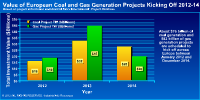 Click on the icons at right to see the number and dollar value of coal and gas power projects scheduled to kick off in Europe between 2012 and 2014.
In aggregate, the project-spending data obscures an important geographic split on coal-fired power development that stems from the EU's Industrial Emissions Directive (IED), issued in January 2011, commented Lynch. EU member nations are required to implement the IED in their national energy policies by 2013. It replaces seven other existing directives aimed at preventing and controlling emissions into air, water and soil, as well as overseeing waste management, energy efficiency and accident prevention. Some of the leading nations have called for carbon capture and sequestration (CCS) technology to be included on all new-build coal-fired generators. Large combustion plants--including coal-, gas- and oil-fired power plants--have longer to comply with the stricter regulations. After 2016, owners of older power plants can choose to invest in technologies--like CCS--for cleaning up emissions, or choose to shut down the plant before 2024 or after 17,500 operating hours.
"Although global use of coal has surged and is expected to continue growing sharply, EU countries will see very little of that growth," Lynch said in an interview. Among the 27 EU nations, about 28% of their electricity was generated from coal in 2008, according to the International Energy Agency (IEA) (Paris, France).
Between 2008 and 2010, coal lost market share to gas and nuclear in EU nations. But the March 2011 Fukushima Daiichi nuclear accident dramatically slowed nuclear's renaissance in several EU nations. For more on that issue, see May 15, 2011, article - Debt Crises and Fukushima Meltdown Still Shake European Power Industry.
Lynch noted that some EU members may be forced to fast-track more gas power projects--and even a few coal-fired projects--given public resistance to nuclear power following the Fukushima accident. Germany's surprise decision to prematurely close its operating nuclear generators and terminate plans to develop new units is expected to force an accelerated timetable for building new generation online. Germany predicted that as it phases out nuclear power over the next decade, it will need to build another 20,000 MW of fossil-fuel powered plants-- mostly gas-fired--to replace that lost generation.
Power planners in EU countries are being squeezed by the same regulatory and political forces shaping U.S. power development, Lynch noted: "Emissions restrictions are making it more expensive to build coal-fired plants in Western and Central Europe, while a combination of anti-coal public opinion, political pressure and environmental protests make it harder for coal-fired plants to get past the planning stage. Some European countries, like the U.K., have refused to grant planning permission for any new coal-fired plants unless they are equipped with CCS technology. But that technology, while progressing, is still in a pre-commercial stage. I think it will be a few years before we see commercial-scale CCS."
More than 200 CCS projects are under way around the world, she continued, citing data from the Global CCS Institute (Canberra, Australia). She said it was encouraging to see such a broad array of national governments, power plant operators, technology companies and engineering & construction (E&C) firms investigating the performance and economics of this category of technologies.
A report from Alstom SA (ENX:ALO) (Levallois-Perret, France) projected that fossil fuel-powered plants using CCS technology can be as cost-effective as renewable energy sources. Alstom, which is running 13 pilot and demonstration CCS projects around the world, used independent experts to collate the costs and performance to conclude that CCS can be "cost effective."
Italian energy giant Enel SpA (BIT:ENEL) (Rome) commissioned Italy's first CCS plant at the Federico II coal-fired power station in Brindisi, in the southeast of the country. The government in Poland, Europe's largest coal-burning nation, finally released a CCS roadmap to help secure its energy future and guide a reduction in power plant emissions. Today, almost 90% of Poland's electricity is produced from coal and lignite. There are two key CCS projects under way at the Belchatow and Kedzierzyn-Kozle coal-fired plants.
But Lynch cautioned that CCS technology has yet to be proven on a commercial scale, which is why she sees EU nations continuing their "dash to gas" over the next few years. "In the coming years, gas-fired generation in Europe will continue to increase in importance as countries make the transition to a low-carbon power sector. Emitting roughly half the carbon dioxide (CO2) as an equivalent coal-fired plant, gas-fired plants have become the fossil-fuel power plant of choice."
Some market sizing estimates predict up to 70,000 MW of new gas-fired generation will be built across Europe by 2017. The U.K., Germany and France lead the charge for new gas-fired plants and are expected to begin construction of a combined 36,550 MW of new gas-fired generation by 2017.
"The U.K. is facing a severe energy crisis as an estimated 25% of its current generating capacity--mainly old coal and nuclear power plants--is on track to be shut down by 2016 in response to the Large Combustion Plant Directive (LCPD)," noted the Industrial Info Europe president. "That works out to about 11,500 MW of generating capacity. For that reason, the U.K. has been a full participant in the continent's 'dash to gas.' Industrial Info Europe is tracking more than 12,000 MW of new gas generation in the U.K. that is under construction or has received regulatory approval."
The U.K. government has just set out a raft of proposals to help kick-start investment in new gas-fired power plants. Edward Davey, the Energy and Climate Change Secretary, has revealed contentious measures to be included in the forthcoming Electricity Market Reform legislation to provide certainty to gas investors. This includes allowing all new gas-fired plants to run without any CCS technology until 2045. The controversial decision to allow gas-fired plants to sidestep the CCS requirements for coal-fired plants has been attacked by renewable energy and environmental bodies. However, with the U.K. facing an energy crisis in the coming decade driven by the closure of older coal-fired and nuclear power plants, the government views new gas-fired plants as essential to filling the gap and legislation to accelerate this process.
But non-EU nations like Turkey, the Ukraine and Russia are forging ahead with new-build coal-fired power development plans, Lynch observed. The Turkish government has announced plans to build 15,000 MW of new coal-fired generation. More than half of this--7,774 MW--is under construction today. Turkey has about 9,000 MW of coal-fired generation operating today. "Coal is expected to play a prominent role in Turkey's electricity future," she said.
New-build coal also is thriving in the Ukraine and Russia, where Industrial Info Europe is tracking billions of dollars of projects scheduled to kick off by yearend 2014. Some of those nations are eager to join the EU, but the price of admission could mean some of those coal projects are converted to gas, outfitted with CCS or abandoned altogether, Lynch said.
The dramatic changes driving fossil fuel power development in Europe are important reasons for industry participants to attend a major upcoming convention and trade show--Power-Gen Europe, which will be held June 12-14 in Cologne, Germany. Industrial Info Europe will be exhibiting at that event at Booth 6E96. Industrial Info's booth will be staffed by Power Industry experts like Lynch and members of her team, who will be happy to demonstrate the online tools and customized analytic services that participants can use to track major developments across the continent and improve their business prospects there.
"When uncertainty is high, industry events like Power-Gen Europe provide opportunities for companies that sell equipment or services to the European power market to lower their risk profile and recalibrate their sales and business strategies," Lynch said. "The networking and the conference sessions provide attendees with valuable market intelligence to help them better understand the risks and rewards of pursuing business opportunities in the European Power sector," she said.
View Plant Report - 1082265 3047024 3034896 3037795 3037565 1084362 1084347
View Project Report - 300029142 300057949 300043478 300047102 300046667 300021717 300046983
Industrial Info Resources (IIR), with global headquarters in Sugar Land, Texas, and eight offices outside of North America, is the leading provider of global market intelligence specializing in the industrial process, heavy manufacturing and energy markets. Industrial Info's quality-assurance philosophy, the Living Forward Reporting Principle, provides up-to-the-minute intelligence on what's happening now, while constantly keeping track of future opportunities.
/news/article.jsp
false
Want More IIR News Intelligence?
Make us a Preferred Source on Google to see more of us when you search.
Add Us On GoogleAsk Us
Have a question for our staff?
Submit a question and one of our experts will be happy to assist you.

Forecasts & Analytical Solutions
Where global project and asset data meets advanced analytics for smarter market sizing and forecasting.
Learn More
Industrial Project Opportunity Database and Project Leads
Get access to verified capital and maintenance project leads to power your growth.
Learn MoreIndustry Intel
-
2026 Regional Chemical Processing OutlookOn-Demand Podcast / Mar. 2, 2026
-
From Data to Decisions: How IIR Energy Helps Navigate Market VolatilityOn-Demand Podcast / Nov. 18, 2025
-
Navigating the Hydrogen Horizon: Trends in Blue and Green EnergyOn-Demand Podcast / Nov. 3, 2025
-
ESG Trends & Challenges in Latin AmericaOn-Demand Podcast / Nov. 3, 2025
-
2025 European Transportation & Biofuels Spending OutlookOn-Demand Podcast / Oct. 27, 2025