Automotive
"Cash for Clunkers" Program Provides Much-Needed Sales Boost for Struggling Automotive Sector
With automotive sales struggling since last year and two of the Detroit Three recently emerging from bankruptcy protection, the automotive sector has been struggling to...
Released Wednesday, August 12, 2009
Researched by Industrial Info Resources (Sugar Land, Texas)--With automotive sales struggling since last year and two of the Detroit Three recently emerging from bankruptcy protection, the automotive sector has been struggling to keep its collective head above water throughout 2009. No automotive company, foreign or domestic, has waded through these tough economic times unscathed. To help the automakers jumpstart sales once again, the federal government stepped in with the "Cash for Clunkers" program, which offered cash incentives for consumers who were willing to trade in less fuel-efficient vehicles in order to purchase vehicles with higher fuel efficiency. All indications are that the program has started well. Automotive sales for the month of July were the best since August 2008.
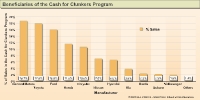
Click on image at right for a breakdown of the automotive manufacturers that have benefited from the "Cash for Clunkers" program.
 The program burned through its initially allocated $1 billion within days, forcing Congress to step in and, after much debate, add $2 billion to the program to keep it up and running. This additional funding could potentially lead 500,000 vehicle sales in the coming weeks. The program is now funded through Labor Day, at which time the government will take a look at the results and determine if additional funding should be allocated.
While the program is certainly working, it does not address the core issues facing the U.S. automotive sector. The program will boost sales as long as the government is willing to continue the subsidy. However, the "Cash for Clunkers" program is going to run used-vehicle lots out of business simply because the vehicles being traded in are destroyed rather than resold. How long will the government be willing or even able to subsidize this program simply to boost automotive sales?
On the other side of the coin, scrap yards are extra busy these days, thanks to the program and its destruction criteria. However, while more and more vehicles are making their way to scrap yards for destruction, there is discontent in this realm as well. According to the legislation, the engine and drive train of each "clunker" cannot be resold; they must be destroyed. These two parts of a vehicle typically account for 60% of the profit of scrapping a vehicle, and the loss of this profit is causing a definite problem for the scrap yards.
While these two lucrative parts are off limits, the balance of the vehicle is free game for the scrap yards. Other parts of the vehicles will certainly make their way to the sales side of the business, although with the sheer volume with which scrap yards are initially having to deal, they often do not have the time or space to store all of the usable parts from the 'clunkers' and are forced to scrap the entire vehicle--sans tires, of course.
The downstream effect this program is going to have on the thousands of used-car lots across the country is unknown. Most experts feel that if the program continues for any length of time, it could devastate this segment of the automotive sector. In addition, used-parts businesses will eventually begin to suffer as the supply of used parts begins to dry up.
While the "Cash for Clunkers" program has initially been a success and is boosting automotive sales across the board, how long can this program continue to be financed by taxpayers--especially at $2 billion a month? Of course the program will not be able to continue indefinitely for the simple reason that there are not that many vehicles out there to be traded in. The program will also eventually hit a financing wall in which the consumers wanting to make trade-ins cannot be financed for new vehicles--no matter how rich the incentive programs become.
For now, though, the program is an unqualified success and is accomplishing exactly what it is supposed to do: boost automotive sales. As the economy recovers from the recession and financing for vehicles begins to loosen up, programs such as this will not be necessary. Now, the automakers must begin to produce vehicles that the public actually wants to purchase, rather than assembling three or four of the exact same vehicle, placing a different brand and model name on each and labeling them "new" vehicles.
Industrial Info Resources (IIR) is the leading provider of global market intelligence specializing in the industrial process, heavy manufacturing and energy related markets. For more than 26 years, Industrial Info has provided plant and project opportunity databases, market forecasts, high resolution maps, and daily industry news.
/news/article.jsp
false
Want More IIR News Intelligence?
Make us a Preferred Source on Google to see more of us when you search.
Add Us On GoogleAsk Us
Have a question for our staff?
Submit a question and one of our experts will be happy to assist you.

Forecasts & Analytical Solutions
Where global project and asset data meets advanced analytics for smarter market sizing and forecasting.
Explore Our Solutions
Industrial Project Opportunity Database and Project Leads
Get access to verified capital and maintenance project leads to power your growth.
Discover Our DatabaseIndustry Intel
-
2026-2027 Investment Radar for Mexico, Central America & the CaribbeanPodcast Episode / May 29, 2026
-
Innovations Shaping the Next Era of Power GenerationPodcast Episode / May 22, 2026
-
The Role of Contract Manufacturing in Global Pharma GrowthPodcast Episode / May 8, 2026
-
2026 North American Labor OutlookPodcast Episode / Apr 24, 2026
-
2026 European Metals & Minerals Project Spending OutlookPodcast Episode / Apr 7, 2026