Petroleum Refining
U.S. Refiners to Spend More Than $800 Million to Remove Benzene from Gasoline
U.S. oil refiners will spend about $832 million on engineering and construction projects to lower the benzene content of their gasoline during the next few years, according to data ...
Released Tuesday, October 06, 2009

Written by John Egan for Industrial Info Resources (Sugar Land, Texas)--U.S. oil refiners will spend about $832 million on engineering and construction projects to lower the benzene content of their gasoline during the next few years, according to data collected by Industrial Info.
These 25 projects are required by the U.S. Environmental Protection Agency (EPA), which in 2007 issued a rule on mobile source air toxins (M-SAT). Phase 2 of that rule (M-SAT-2), which has an effective date of January 1, 2011, for most refiners, sets a new standard for the allowable benzene content of gasoline. "Small refiners," as defined by the EPA, will be given extra time to comply with the new volumetric standard for benzene.
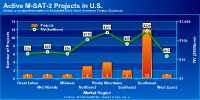 Click on image at right for a regional breakdown of active M-SAT-2 projects.
About half of the projects are located in the Southwest. The Rocky Mountain region has the second-largest regional aggregate dollar value of projects, with four projects worth an estimated $257 million.
"Refiners' margins have been squeezed, and sometimes they become negative, which causes refiners to postpone or cancel capital construction projects to increase throughput," said Chris Paschall, Industrial Info's vice president of research for the petroleum refining industry, in an interview. "But these M-SAT-2 projects can't be deferred if a refiner wants to stay in compliance."
Paschall said 20 of the 25 projects are in the "planning" stage, meaning that equipment vendors and service suppliers still may be able to submit bids for work. He said that M-SAT-2 projects at small refineries typically are not even in the planning phase, signaling additional potential bidding opportunities.
"These construction projects are good news for engineering and construction firms, even though they're not particularly good news for refiners," Paschall said. "If you're not making any money, it's hard when the government tells you to increase spending for environmental compliance."
According to Industrial Info's database, refiners have awarded M-SAT-2 projects to:
- Mustang (Houston, Texas), a unit of John Wood Group plc (LSE:WG) (Aberdeen, Scotland)
- Jacobs Engineering Group (NYSE:JEC) (Pasadena, Calif.)
- Ambitech Engineering (Downers Grove, Illinois)
- Burns & McDonnell (Kansas City, Missouri)
M-SAT-2 construction projects likely will cause refiners to delay or cancel other capital projects to expand throughput capacity, Paschall said, adding that market conditions were having that effect already. "We're swimming in gasoline right now. Refiners have been delaying expansion projects because market conditions have been unfavorable."
U.S. gasoline inventories stand at 212.5 million barrels at the end of September, according to data released September 29 by the American Petroleum Institute. Gasoline storage levels unexpectedly fell by 1.7 million barrels from the previous week, API said.
The M-SAT-2 rule, finalized by EPA in 2007, requires refiners to lower the benzene content of their gasoline pool to 0.62% by volume, according to the agency. Small refiners are given additional time to meet the standards of M-SAT-2. To qualify for "small refiner" status, a refiner must have produced gasoline during 2005; had no more than 1,500 employees, on average, for that year; and had an average crude oil capacity of no more than155,000 barrels of oil per calendar day for 2005.
The rule does allow benzene averaging, banking and trading among refiners. Refiners also are eligible for "standard credits" if their gasoline pool had benzene content under 0.62% during 2004-05. The rule contains incentives for early compliance; imported gasoline may qualify for early compliance credits under some conditions. Early compliance credits will be created if a refiner lowers the average benzene content of its gasoline pool to 0.62% or below before January 2011.
Industrial Info Resources (IIR) is the leading provider of global market intelligence specializing in the industrial process, heavy manufacturing and energy related markets. For more than 26 years, Industrial Info has provided plant and project opportunity databases, market forecasts, high resolution maps, and daily industry news.
/news/article.jsp
false
Want More IIR News Intelligence?
Make us a Preferred Source on Google to see more of us when you search.
Add Us On GoogleAsk Us
Have a question for our staff?
Submit a question and one of our experts will be happy to assist you.

Forecasts & Analytical Solutions
Where global project and asset data meets advanced analytics for smarter market sizing and forecasting.
Explore Our Solutions
Industrial Project Opportunity Database and Project Leads
Get access to verified capital and maintenance project leads to power your growth.
Discover Our DatabaseIndustry Intel
-
2026-2027 Investment Radar for Mexico, Central America & the CaribbeanPodcast Episode / May 29, 2026
-
Innovations Shaping the Next Era of Power GenerationPodcast Episode / May 22, 2026
-
The Role of Contract Manufacturing in Global Pharma GrowthPodcast Episode / May 8, 2026
-
2026 North American Labor OutlookPodcast Episode / Apr 24, 2026
-
2026 European Metals & Minerals Project Spending OutlookPodcast Episode / Apr 7, 2026