
Power
EPC Firms Face Mounting Challenges in $3.6 Trillion Mega-Project World
In spite of uncertain economic direction, the world's demand for energy and resources continues to grow, driving industrial project development for power...
Released Tuesday, October 19, 2010
Researched by Industrial Info Resources (Sugar Land)--It's almost as inevitable as death and taxes. In spite of uncertain economic direction, the world's demand for energy and resources continues to grow, driving industrial project development for power generation, mining, infrastructure, hydrocarbons and petrochemicals. As a result, capital spending will increase significantly in the foreseeable future. More and more, these projects are located in remote parts of the world, with little or no established infrastructure and a sparse skilled labor force, although these projects require complex technical delivery and logistics solutions and have multibillion-dollar price tags.
This is the face of the new mega-project. No longer is a $1 billion project considered large; today's mega-projects carry multibillion-dollar price tags. For example, take Brazilian miner Vale's plans for the grassroot Serra Sul Iron Ore Mine in Brazil. The $11.3 billion project includes a 90 million-ton-per-year open pit iron ore mine, mills, a concentrator, a pellet plant, a 650-kilometer railroad and a port terminal on the coast. This is one of more than 1,400 mega-projects (projects with total investment values of $1 billion or greater) that Industrial Info is tracking worldwide. These projects represent $3.6 trillion in total spending.
Click on the image at right to view a chart showing the breakdown of mega-projects worldwide by region.
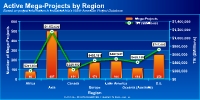 Mega-projects pose unique challenges for engineering, procurement and construction (EPC) firms. The stakes are high. Projects delivered on time and under budget are almost unheard of in today's market.
 Challenges
The workforces at many EPC firms are declining and aging. Attracting and retaining staff is key to the future success of EPC firms and their supply chains. Project work is being done in markets with tight or underdeveloped labor markets. Skilled labor is lacking, or projects are located in expensive places, such as Australia. This is driving project executions offshore.
Logistics is playing a larger role. More and more companies are moving to modularization, fabricating large modular pieces of equipment and pipe racks. This puts pressure on logistics and transportation companies to deliver on time. Speaking at the 2010 Breakbulk Americas Conference last week in Houston, David Hemmerle, the principal vice president and corporate manager for procurement and contracts at Bechtel Corporation (San Francisco, California), said: "We are building more modules, not on a small scale, but large, multi-story modulars that require heavy-lift cranes and transports to move. Logistics is playing a more critical role in what we are going to move these days."
Greg Murray, vice president for procurement at The Shaw Group Incorporated (NYSE:SHAW) (Baton Rouge, Louisiana) also spoke at the Breakbulk conference and mentioned the importance of modularization in today's market. Mr. Murray said, "Modularization is the future for these mega-projects. Shaw is constructing a 400,000-square-foot fabrication shop in Abu Dhabi to allow the construction of modules."
The scope and the size of projects today is more complex. A $1 billion project was big a few years ago, but now it's the norm, and these projects are located in areas of challenging logistics and poor infrastructure. According to Mr. Hammerle, the EPC firm supply base has been consistently underperforming with respect to quality and schedule. Some delays can be attributed to overbooking of fabrication shop capacity, which is currently at about 90-100%.
Companies are looking to lower costs and find new suppliers. This had led to a tremendous global dispersion of the supply chain, with primary suppliers, sub-prime suppliers and even sub-sub-prime suppliers not uncommon. These complex relationships between primary and sub-prime suppliers create a problem for EPC firms in not only managing the contract supply, but also in quality control.
Counterfeit equipment and materials is becoming a serious issue for EPC firms, and fraud and suspect items are a growing concern. Mr. Hammerle continued: "We are working with the Construction Industry Institute on what impact this is having on our industry. It's an increasing problem, from falsified paperwork to fake materials or counterfeit materials. Everyone should be on guard."
View Project Report - 67000817
Industrial Info Resources (IIR) is the leading provider of global market intelligence specializing in the industrial process, heavy manufacturing and energy markets. IIR's quality-assurance philosophy, the Living Forward Reporting Principle, provides up-to-the-minute intelligence on what's happening now, while constantly keeping track of future opportunities.
/news/article.jsp
false
Want More IIR News Intelligence?
Make us a Preferred Source on Google to see more of us when you search.
Add Us On GoogleAsk Us
Have a question for our staff?
Submit a question and one of our experts will be happy to assist you.

Forecasts & Analytical Solutions
Where global project and asset data meets advanced analytics for smarter market sizing and forecasting.
Learn More
Industrial Project Opportunity Database and Project Leads
Get access to verified capital and maintenance project leads to power your growth.
Learn MoreIndustry Intel
-
2026 Regional Chemical Processing OutlookOn-Demand Podcast / Mar. 2, 2026
-
From Data to Decisions: How IIR Energy Helps Navigate Market VolatilityOn-Demand Podcast / Nov. 18, 2025
-
Navigating the Hydrogen Horizon: Trends in Blue and Green EnergyOn-Demand Podcast / Nov. 3, 2025
-
ESG Trends & Challenges in Latin AmericaOn-Demand Podcast / Nov. 3, 2025
-
2025 European Transportation & Biofuels Spending OutlookOn-Demand Podcast / Oct. 27, 2025