Production
BP: Permian Basin Productivity Gains Begin to Flatten Out
Logistical bottlenecks in the Permian Basin, shown in part by its sharp growth in drilled but uncompleted wells, have led to a plateauing of productivity gains in that basin
Released Wednesday, June 27, 2018
Written by John Egan for Industrial Info Resources (Sugar Land, Texas)--Logistical bottlenecks in the Permian Basin, shown in part by its sharp growth in drilled but uncompleted (DUC) wells, have led to a plateauing of productivity gains in that basin, BP plc (NYSE:BP) (London, England) Chief Economist Spencer Dale said June 13 in unveiling that company's annual statistical review of world energy.
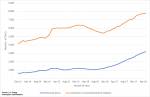 Click on the image at right to see a chart of DUCs in the Permian Basin and for all U.S. unconventional formations.
A central factor in crude-oil production gains in unconventional formations over the past five or six years has been "the strong and continuous gains in productivity, as technology and know-how have improved," Dale said. "However, the most recent data for the Permian, which has accounted for around two-thirds of the increase in U.S. tight oil since 2017, paint a sharply different picture. In particular, using conventional measures based on 'initial output per rig,' measured productivity fell sharply in the second half of 2016 and the first half of 2017, before recovering somewhat in the second half of last year."
Dale continued: "But much of the fall in this conventional measure of productivity was driven by a sharp decline in the rate at which drilled wells were subsequently fracked and completed--as the supply chain within the Permian tightened and drilling processes became more complex--rather than by a fall in the underlying productivity of the wells drilled."
In other words, the Permian's large number of DUC wells distorted conventional productivity measurements and made the region's productivity seem worse than was actually true.
So BP reassessed Permian productivity using metrics that were modified from the conventional measurement of "initial output per well." Specifically, BP controlled for the changes in the well completion rates by calculating what it called the "initial output per completed well," which showed a gradual flattening, not a dramatic one. The oil and gas giant then took another conventional metric of productivity, "initial output per lateral foot of each well," and tweaked it to become "initial output per lateral foot of each completed well." That, too, showed a more gradual decline in productivity, not the steep drop indicated by the conventional productivity metrics.
Using these modified measurements of productivity, the BP group chief economist concluded productivity in the Permian declined slightly, not dramatically, during 2017.
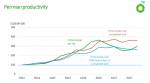 Click on the image at right to see the various measures by which BP documented the flattening productivity growth in the Permian Basin.
"It is perhaps not surprising that as U.S. tight oil output has increased rapidly (in recent years), causing production to spread out from the sweetest spots, productivity has begun to flatten out," Dale said. "And, importantly, this measure of productivity doesn't link directly to profitability, if the cost of drilling continues to fall or if acreage is drilled more intensely. But it does, perhaps, suggest that the very rapid increases in tight oil productivity that characterized much of the initial phase of the shale revolution may be beginning to fade."
Dale's comments on logistical bottlenecks in the Permian echoed recent statements by other observers, including one logistics consultant who predicted some production would have to be shut-in over the next few months until the pipeline bottlenecks were removed. This consultant thought that might take more than a year. For more on that, see June 20, 2018, article - Consultant: Lack of Permian Pipeline Capacity will Force Production Curtailments.
Crude oil production in the Permian is expected to continue growing, at least for the next month, according to the U.S. Energy Information Administration (EIA) (Washington, D.C.). The agency's most recent Drilling Productivity Report, released June 18, predicted crude oil production in the Permian would grow about 73,000 barrels per day (BBL/d) in July, to an estimated 3.35 million BBL/d.
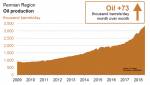 Click on the image at right to see actual and projected Permian Basin crude oil production gains.
A slowdown in productivity gains in the Permian could cast a shadow over the U.S. unconventional crude-oil production, given that the Permian accounts for the majority of production from those formations. While other unconventional formations have increased production modestly over the last year, Permian producers have added about 1 million BBL/d since July 2017.
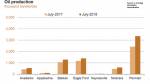 Click on the image at right to see graphics depicting crude oil production from all U.S. unconventional formations.
BP's Dale did not hazard a guess as to how flattening productivity gains in the Permian Basin could affect global supply, demand and prices for crude oil. The world energy review documented strong demand growth in 2017, an increase of about 1.7 million BBL/d, about the same as in 2016 but sharply higher than the average annual growth of about 1.1 million BBL/d over the last 10 years.
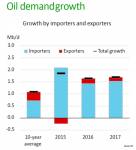 Click on the image at right to see a graphic of global crude-oil demand growth in 2015, 2016 and 2017, compared with average annual demand growth for the prior 10 years.
Crude-oil production decisions by the Organization of Petroleum Exporting Countries (OPEC) (Vienna, Austria) are the other force affecting global oil markets. OPEC met about a week after BP released its annual energy statistical report. OPEC, plus Russia, had maintained the production cuts agreed to in 2016. Those cuts, plus the dramatic reduction of oil production by Venezuela, currently wracked by civil strife, have effectively removed nearly 2 million BBL/d from global oil markets. Production declines, coupled with demand growth, have drawn down global inventories of crude oil to their five-year historical average, Dale noted.
The BP economist likened the crude oil business to the 1980s TV drama "Dallas," which he said lurched from crisis to crisis each week, "with building tension and intrigue, often ending at nail-biting moments." It may be too early to speculate on exactly how OPEC's increased production, coupled with flattening productivity gains in the Permian Basin, could affect global oil supply, demand and prices. OPEC countries have agreed to increase production by a reported 600,000 BBL/d to 800,000 BBL/d. And so begins the next episode of crude oil's long-running drama.
Industrial Info Resources (IIR), with global headquarters in Sugar Land, Texas, six offices in North America and 12 international offices, is the leading provider of global market intelligence specializing in the industrial process, heavy manufacturing and energy markets. Industrial Info's quality-assurance philosophy, the Living Forward Reporting Principle, provides up-to-the-minute intelligence on what's happening now, while constantly keeping track of future opportunities. Follow IIR on: Facebook - Twitter - LinkedIn. For more information on our coverage, send inquiries to info@industrialinfo.com or visit us online at http://www.industrialinfo.com/.
/news/article.jsp
false
Want More IIR News Intelligence?
Make us a Preferred Source on Google to see more of us when you search.
Add Us On GoogleAsk Us
Have a question for our staff?
Submit a question and one of our experts will be happy to assist you.

Forecasts & Analytical Solutions
Where global project and asset data meets advanced analytics for smarter market sizing and forecasting.
Explore Our SolutionsRelated Articles
-
U.S. Consumers Mull EVs Amid Higher Gasoline PricesMay 15, 2026
-
Vessel Seized in UAE WatersMay 14, 2026
-
U.S. LNG Levels Off from Early-Year PeaksMay 14, 2026

Industrial Project Opportunity Database and Project Leads
Get access to verified capital and maintenance project leads to power your growth.
Discover Our DatabaseIndustry Intel
-
The Role of Contract Manufacturing in Global Pharma GrowthPodcast Episode / May 8, 2026
-
2026 North American Labor OutlookPodcast Episode / Apr 24, 2026
-
2026 European Metals & Minerals Project Spending OutlookPodcast Episode / Apr 7, 2026
-
The Age of Critical Minerals in the AmericasPodcast Episode / Mar 20, 2026
-
2026 Regional Chemical Processing OutlookPodcast Episode / Mar 6, 2026