Industrial Manufacturing
Rail Projects Totaling $118 Billion Under Construction or Planned in the United States
During the past several decades, rail expenditures have been growing on an annual basis. As oil prices and, as a result, gas prices, have increased in recent...
Released Monday, June 29, 2009
Researched by Industrial Info Resources (Sugar Land, Texas)--During the past several decades, rail expenditures have been growing on an annual basis. As oil prices and, as a result, gas prices, have increased in recent years, many states, counties and cities have increased their interests in rail investment as it provides a method of mass transportation that does not revolve around the price of oil. However, during the Bush administration, rail was not high on the agenda, and governmental financing was hard to come by. With President Obama taking office this year, interest in rail investment has increased dramatically. This can easily be seen in portions of the stimulus bill that allocated billions of dollars to rail projects, as well as the high-speed rail initiative that the president has put forth.
Industrial Info is currently tracking 90 freight, commuter or light rail projects worth an estimated $17.5 billion that are currently under construction in the U.S. In addition, with the added emphasis that the Obama administration has placed on rail projects, more than 100 additional projects representing $101 billion are in various stages of planning in the U.S.
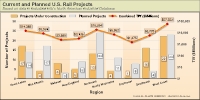 Click on image at right for a regional breakdown of current and planned rail projects in the U.S.
The rail sector really breaks down into two parts: freight rail and passenger rail, with passenger rail including both light and commuter rail projects. On the freight rail side of the equation, companies such as CSX Corporation (NYSE:CSX) (Jacksonville, Florida), Burlington Northern Santa Fe Corporation (NYSE:BNI) (Fort Worth, Texas) and Union Pacific Corporation (NYSE:UNP) (Omaha, Nebraska), plus the balance of the class-one railroads spend close to, if not more than, $1 billion each annually on expansions, upgrades and maintenance work across the nation's freight rail system. These projects are necessary to keep the freight rail system running efficiently and to maintain a state of good repair on the track and facilities that support it.
For light and commuter rail, the expenditures tend to be much higher but take place over a much longer period of time. The majority of the dollars being spent on the aforementioned projects will fall into the light and commuter rail categories because of the nature of the projects. Light and commuter rail projects take five-plus years to develop and tend to cost anywhere from $5 million when dealing with smaller, maintenance type projects, all the way up to $45 billion for an 800-mile grassroot high-speed rail system.
In examining where the projects currently under construction are located, we can see some of the more traditional mass-transit hubs of the nation get much of the attention. The Northeast region of the country has the majority of the rail projects that are currently under construction--22, worth an estimated $4.9 billion. The West Coast, with its well developed mass transit systems, is a close second place, with 13 projects worth $3.7 billion, while the Mid-Atlantic region, consisting of the states of Maryland, West Virginia, Virginia, North Carolina and South Carolina, maintains a solid hold on third place with 17 projects worth $3.1 billion.
Looking ahead at those projects still in the planning stages, the breakdown of where these projects will take place is very similar. Currently, the West Coast region, mainly because of its massive 800-mile high-speed rail project that is in the planning stages, has a solid hold on first place with 23 projects worth $52.5 billion. The Northeast region takes second place in this category of projects with 24 projects worth $14.5 billion, while third place is held by the Great Lakes region with 14 projects worth $11.2 billion.
Overall, we can expect to see the number of projects moving from the "planned" list to the "under construction" list to increase throughout the Obama presidency simply because this administration recognizes the value of these types of projects and is willing to step up to the plate and help get them financed. Hopefully, the government will increase the funding going to both the freight and passenger sides of the sector and not simply focus on moving people. That said, the next four years should be banner times for the rail sector with the increased federal interest in rail projects. Hopefully, the balance will tip in favor of projects actually reaching construction, rather than having project languishing in the financing stages for years. The rail sector could be a powerful force in the fight to end the recession because of the number of multi-year construction jobs it can create, a fact that hopefully will not go unrecognized.
Industrial Info Resources (IIR) is the leading provider of global market intelligence specializing in the industrial process, heavy manufacturing and energy related markets. For more than 26 years, Industrial Info has provided plant and project opportunity databases, market forecasts, high resolution maps, and daily industry news.
/news/article.jsp
false
Want More IIR News Intelligence?
Make us a Preferred Source on Google to see more of us when you search.
Add Us On GoogleAsk Us
Have a question for our staff?
Submit a question and one of our experts will be happy to assist you.
Forecasts & Analytical Solutions
Where global project and asset data meets advanced analytics for smarter market sizing and forecasting.
Learn More
Industrial Project Opportunity Database and Project Leads
Get access to verified capital and maintenance project leads to power your growth.
Learn MoreIndustry Intel
-
2026 North American Labor OutlookPodcast Episode / Apr 24, 2026
-
2026 European Metals & Minerals Project Spending OutlookPodcast Episode / Apr 7, 2026
-
The Age of Critical Minerals in the AmericasPodcast Episode / Mar 20, 2026
-
2026 Regional Chemical Processing OutlookPodcast Episode / Mar 6, 2026
-
From Data to Decisions: How IIR Energy Helps Navigate Market VolatilityPodcast Episode / Nov 21, 2025