Power
U.S. Coal-Fired Power Plant Retirements Slowed in 2025, Future is Uncertain
The U.S. electricity generators retired about 2,600 megawatts (MW) of coal-fired generating capacity in 2025, less than one-third of what they had planned to retire at the beginning of the year, the U.S. Energy Information Administration said.
Released Thursday, April 30, 2026
Written by John Egan for IIR News Intelligence (Sugar Land, Texas)
Summary
The U.S. electricity generators retired about 2,600 megawatts (MW) of coal-fired generating capacity in 2025, less than one-third of what they had planned to retire at the beginning of the year, the U.S. Energy Information Administration said April 13.2025 Coal Plant Retirements Slowest Since 2010
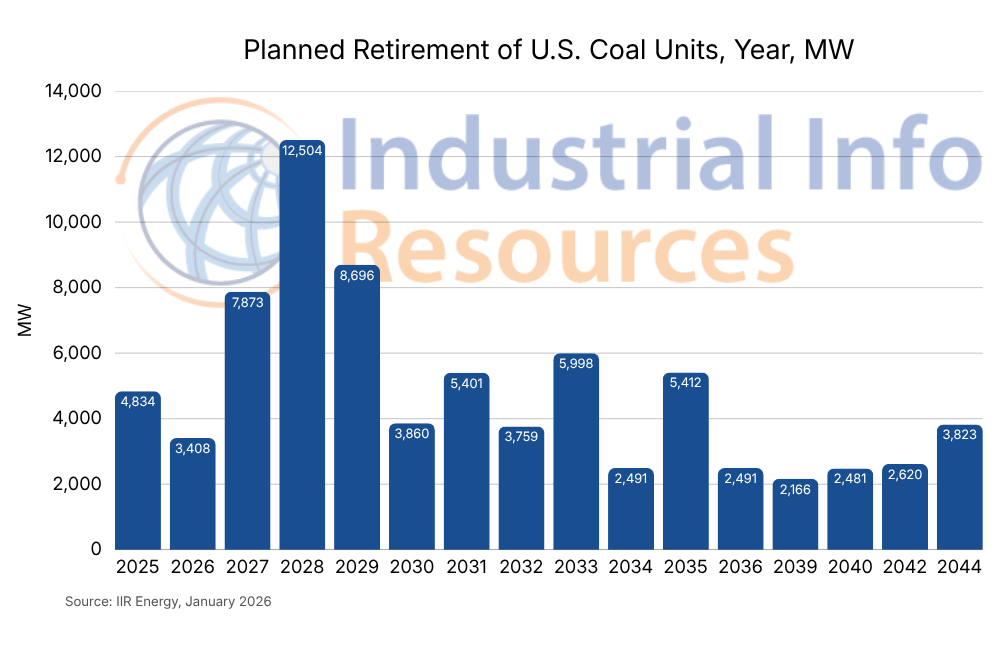
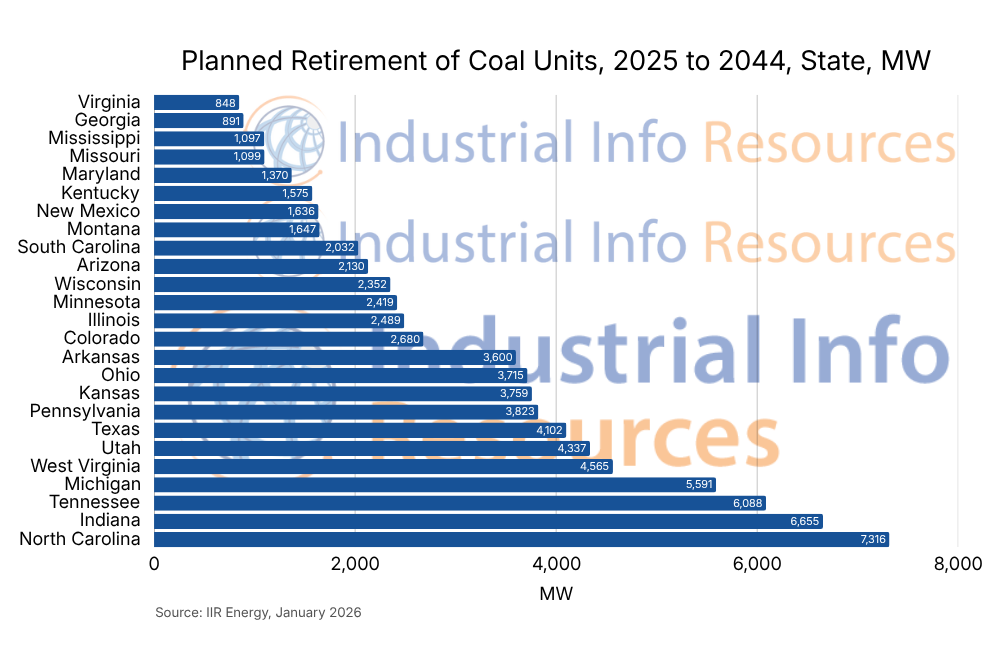
At the start of 2025, U.S. electricity generators planned to retire about 8,500 megawatts (MW) of coal-fired generating capacity during that year. But only about 2,600 MW of those retirements, approximately 30% of planned retirements, actually took place, the U.S. Energy Information Administration (EIA) said April 13. The 2,600 MW of coal-fired retirements was the lowest since 2010, the agency added.According to Industrial Info Resources data, about 36,341 MW of coal-fired generating capacity is scheduled to retire by 2030, though there are significant uncertainties over the timing and pace of future U.S. coal power plant retirements.
One major reason for the significant gap between planned and actual retirements was emergency orders issued by the Trump administration compelling about 3,240 MW of coal-fired power plants to delay their planned 2025 retirement, to ensure there was adequate electric generating capacity to meet the needs of homes and businesses.
Under the Federal Power Act, the Trump administration's emergency "must run" orders initially have a 90-day duration, but can be extended, as the administration has done for at least one plant. The EIA said that most operators of the plants whose 2025 retirement dates were delayed plan to close those plants in early-to-mid 2026, though the agency noted that could change.
The Trump administration has championed the construction of data centers that power artificial intelligence (AI), and it didn't want to have that future undermined by an inadequate supply of electric generating capacity or an unreliable electric grid. For more on that, see July 17, 2025, article - Big Talk of AI, Power Development at Pennsylvania Summit. It has framed the issue as a race that the U.S. cannot lose to China.
Planned Coal Retirements Total 6,500 MW in 2026
This year, the EIA said, operators of coal-fired generation say they plan to retire about 6,500 MW of coal-fired generating capacity, but those decisions, too, could change "depending on future regulatory decisions or other economic factors." See EIA map below.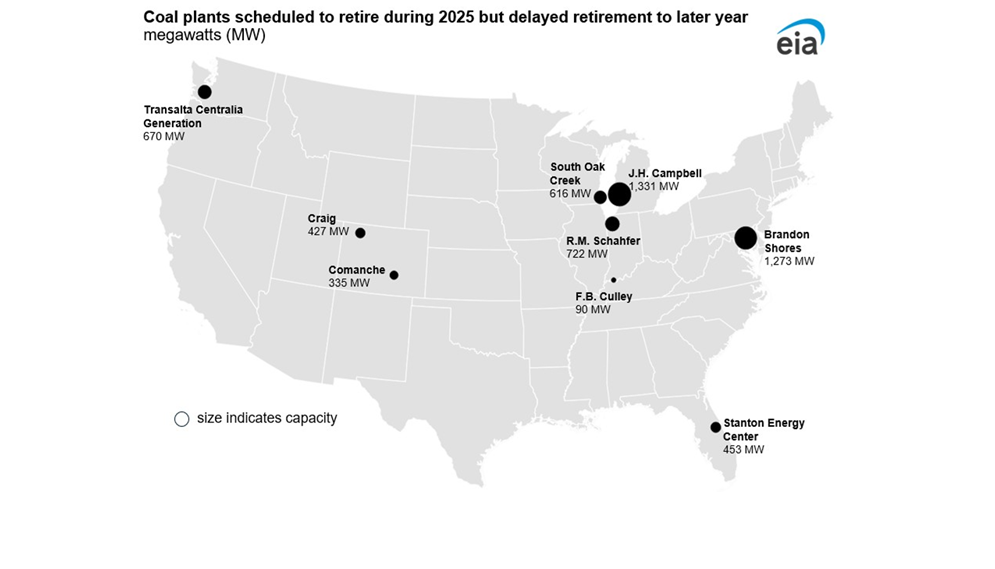
By the Numbers
The EIA said the 3,240 MW of coal-fired generation that received "emergency must run" orders under section 202(c) of the Federal Power Act in 2025 were:
- J.H. Campbell Units 1, 2 and 3 in Michigan (1,331 MW)
- Transalta Centralia Unit 2 in Washington (670 MW)
- R.M. Schahfer Units 17 and 18 in Indiana (722 MW)
- F.B. Culley Unit 2 in Indiana (90 MW)
- Craig Unit 1 in Colorado (427 MW)
- Intermountain Power Project Units 1 and 2 in Utah (1,800 MW)
- Indian River Generating Station Unit 4 in Delaware (410 MW)
- Cholla Units 1 and 3 in Arizona (383 MW)
- Prairie Creek Unit 1 in Iowa (15 MW)
Data Center Electric Demand Growth A Critical Uncertainty
Over the last two years, as data center construction plans skyrocketed in the U.S., electricity providers have sharply increased their planned capital outlays to build new electric generation, transmission and distribution assets to serve the planned new loads. For more on that, see January 2, 2026, article - NiSource Capex Plan Soars 45%, Driven Largely by Planned Data Centers and February 16, 2026, article - Planned Data Centers Drive Up WEC Proposed Capex--Again.However, lengthy interconnection queues and long lead-times for utilities to build new assets have caused some data center developers and Big Tech companies to incorporate self-generation into their data center campus plans. Typically, this generation would either use natural gas or renewables coupled with battery energy storage. If this trend continues, electricity providers may need to lower projected capital investments to serve data center loads.
Planned retirement of coal-fired generation also could be affected, as large electric loads that utilities have been planning to serve don't materialize as planned.
A growing swath of people and organizations are opposing construction of data centers in their communities, citing data centers' undesirable effect on electricity prices, water availability, the environment and land use in their communities. For more on that, see April 8, 2026, article - Data Center Opposition Growing Across States.
As well, a growing number of state utility regulators have installed guardrails to ensure that data centers pay for themselves and don't shift costs to residential or other commercial customers.
New Report Casts Doubt on Data Center Demand Growth
A different agency, the International Energy Agency (IEA) recently analyzed the impact that AI could have on the energy industry. It contained four scenarios about how global data center and AI use could drive future electricity demand.That report, "Key Questions on Energy and AI," released April 16, predicted that nearly half of projected electric demand growth in the U.S. through 2035 would come from data centers. For more on that report, see April 23, 2026, article - IEA: Data Centers Pose Challenge to Global Power Industry.
But the IEA noted that there are various factors that could accelerate or decelerate the speed of data center electric demand growth from the agency's "Base" case.
One factor is the sharp, even unprecedented, increases in energy efficiency with which data centers perform tasks. Continued advances in data center energy efficiency could reduce the number of coal-fired power plants that need to remain open to serve large electric loads represented by data centers and AI.
Neither the IEA nor the EIA reports explored how data center and AI trends could affect the planned retirement of U.S. coal-fired power plants. But if the sector that represents nearly half of projected U.S. electric demand growth to 2035 slows significantly, it would influence the need for new power plants, using whatever fuel, or the "emergency" need to postpone retirement of aging coal-fired generators.
Britt Burt, Industrial Info Resources' senior vice president of research for the global electric power industry, remarked, "My favorite philosopher, Yogi Berra, has two sayings about the future that come to mind when thinking about electric demand growth and data centers: 'the future ain't what it used to be,' and 'it's hard to make predictions--especially about the future.' Both were true then, and they remain so today."
- Owners of U.S. coal-fired electric generation only retired about 30% of plants they had planned to retire in 2025.
- The biggest reason for the delayed retirements was the Trump administration's use of the Federal Power Act to issue "emergency must run" orders for a handful of coal-fired power plants.
- However, there are several trends involving data centers and AI that could affect planned retirements of coal-fired generators over the next few years as well as the need for generators' to build more electric generating capacity.
About Industrial Info Resources
Industrial Info Resources (IIR) is the leading provider of industrial market intelligence. Since 1983, IIR has provided comprehensive research, news and analysis on the industrial process, manufacturing and energy related industries. IIR's Global Market Intelligence (GMI) helps companies identify and pursue trends across multiple markets with access to real, qualified and validated plant and project opportunities. Across the world, Industrial Info Resources is tracking over 250,000 current and future projects worth $30.2 Trillion (USD).
Want More IIR News Intelligence?
Make us a Preferred Source on Google to see more of us when you search.
Add Us On GoogleAsk Us
Have a question for our staff?
Submit a question and one of our experts will be happy to assist you.

Forecasts & Analytical Solutions
Where global project and asset data meets advanced analytics for smarter market sizing and forecasting.
Explore Our SolutionsRelated Articles
-
Europe's Mild Winter Outlook Tests Natural Gas PreparednessOctober 16, 2026
-
South Korea's US$747 Billion Energy Transition PlanOctober 16, 2026
-
Trump Admin Continues Offshore Wind War with Revolution Wind...October 15, 2026
-
U.S. Nuclear Body Gives Second SMR Permit in Six MonthsOctober 15, 2026
-
Europe Makes its First SMR InvestmentOctober 14, 2026

PECWeb Global Market Intelligence Platform
Identify opportunities, anticipate change, and execute with confidence. PECWeb connects the industrial intelligence you need, from projects and assets to operational events, all in one platform.
Discover PecwebIndustry Intel
-
Brazil Critical Minerals 2027: Rare Earths, Lithium, CopperPodcast Episode / Oct 16, 2026
-
US Craft Labor Outlook 2026: Wages, Per Diems, Data CentersPodcast Episode / Oct 16, 2026
-
Latin America Data Center Outlook 2026: Power, Hubs & GrowthPodcast Episode / Oct 9, 2026
-
Food and Beverage CapEx Outlook 2026: Tariffs, AI, AfricaPodcast Episode / Oct 9, 2026
-
North America Refining 2026: New Pipelines to PADD 5Podcast Episode / Oct 2, 2026