Petroleum Refining
EIA: Three Factors Behind Gasoline Demand Drop in China
Gasoline demand in China has begun to decline
Released Friday, November 22, 2024
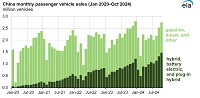
Written by Paul Wiseman for Industrial Info Resources (Sugar Land, Texas)--A list of issues has contributed to a drop in gasoline demand in China in recent months. In August, demand dropped below its corresponding month in 2023 for the first time this year, followed by year-over-year declines in September and October. The most recent figures show gasoline demand in October was below 2023 levels but was still higher than October 2022, according to the China National Bureau of Statistics, China General Administration of Customs, and Bloomberg L.P. as quoted by the U.S. Energy Information Administration (EIA).
"We estimate gasoline consumption in China averaged 3.2 million barrels per day (BBL/d) in August 2024, 14% less than in August 2023," the EIA said. For next year, it said, "China's growth (in the consumption of petroleum and liquid fuels) of 0.1 million BBL/d in 2024 and 0.3 million BBL/d in 2025 will mostly be driven by petrochemical feedstocks instead of transportation fuels, reflecting increased petrochemical manufacturing in the country."
Industrial Info has previously reported the closings of a number of refineries or individual units in recent weeks in China, many due to bankruptcy. Between unit closings and new unit additions and expansions, Industrial Info sees a net 165,000-BBL/d capacity decline between 2024 and 2025. Most of the decline is due to economics, including some older, less-profitable facilities. Some new units planned at the same time will be more efficient and therefore more economical to operate. For more information, see November 5, 2024, article - IIR Data Show China Refinery Capacity to Drop by 165,000 BBL/d by End of 2025.
This matters to global oil prices because China is, by far, the largest oil importing country, bringing in more than 11 million BBL/d in 2023, according to Statista. This is more than all of Europe. Previous estimates from OPEC and others expecting import growth in 2025 over 2024 now seem to be greatly in question.
The EIA suggests three main issues behind shrinking demand: growth in electric vehicles (EVs), slow economic growth and population decline.
Greener Vehicles
EV and battery electric vehicle (BEV) sales growth is part of the reason for the gasoline demand drop, said Hillary Stevenson, senior director, energy market intelligence at IIR Energy, but demand for diesel fuel and other refined products in China is also dropping. She noted that the nation is among the leaders in switching trucks to liquefied natural gas (LNG) and liquefied petroleum gas (LPG), "all of which can reduce refined products demand."
Industrial Info's Geoffrey S. Lakings noted a November 18 Reuters report, explaining that, "The move to LNG is largely driven by price as it is cheaper than diesel, while also delivering some environmental benefits."
For EVs, Reuters identified subsidies for what the Chinese government calls "new energy" vehicles that are encouraging drivers to switch to EVs or hybrids. Since many components and vehicles are made in China, "new energy" vehicle sellers already have a price advantage over fossil-fueled vehicles.
Chinese Economy
The EIA report quoted an Oxford Economics forecast that expects the country's GDP to grow by 4.1% in 2025, "which is slower than the 6.7% GDP growth rate average from 2015 to 2019, before the COVID-19 pandemic. Oil consumption correlates with economic activity," which could reduce gasoline demand.
Despite economic stimulus efforts on the part of the Chinese government, there has been little perceived improvement yet.
This week, Chinese President Xi Jinping has toured South America, seeking more free trade, presumably to improve Chinese manufacturing markets. This is a move some see as a desire get ahead of the fulfilment of U.S. president-elect Donald Trump's promises to raise tariffs on Chinese goods sold in the U.S.
Population Implosion
Due to China's restriction on birth rates, it is no longer the world's most populous nation, having been surpassed in recent years by India.
According to the Peterson Institute for International Economics (PIIE), the nation's total natural population dropped by more than 2 million in 2023. China's 9 million births that year shows the continuance of a significant decline that began in 2016. PIIE said the birth rate "is down by more than 50% in just eight years."
Because of its sheer size--in geography, economy and population--the level of Chinese demand is the elephant in every room of energy price forecasting, and its every move send economic temblors across the globe.
Industrial Info Resources (IIR) is the leading provider of industrial market intelligence. Since 1983, IIR has provided comprehensive research, news and analysis on the industrial process, manufacturing and energy related industries. IIR's Global Market Intelligence (GMI) platform helps companies identify and pursue trends across multiple markets with access to real, qualified and validated plant and project opportunities. Across the world, IIR is tracking more than 200,000 current and future projects worth $17.8 trillion (USD).
/news/article.jsp
false
Want More IIR News Intelligence?
Make us a Preferred Source on Google to see more of us when you search.
Add Us On GoogleAsk Us
Have a question for our staff?
Submit a question and one of our experts will be happy to assist you.

Forecasts & Analytical Solutions
Where global project and asset data meets advanced analytics for smarter market sizing and forecasting.
Explore Our SolutionsRelated Articles
-
War, Refineries Keep U.S. Gasoline Prices ElevatedMay 22, 2026
-
Venezuela's PDVSA Continues with Refinery RepairsMay 20, 2026

Industrial Project Opportunity Database and Project Leads
Get access to verified capital and maintenance project leads to power your growth.
Discover Our DatabaseIndustry Intel
-
Innovations Shaping the Next Era of Power GenerationPodcast Episode / May 22, 2026
-
The Role of Contract Manufacturing in Global Pharma GrowthPodcast Episode / May 8, 2026
-
2026 North American Labor OutlookPodcast Episode / Apr 24, 2026
-
2026 European Metals & Minerals Project Spending OutlookPodcast Episode / Apr 7, 2026
-
The Age of Critical Minerals in the AmericasPodcast Episode / Mar 20, 2026