Power
EIA: U.S. Power Getting Cheaper, Cleaner
Three recent reports from the U.S. Energy Information Administration (EIA) (Washington, D.C.) show the cost of power is declining, as are emissions of carbon dioxide (CO2) and sulfur dioxide (SO2). Increased use of natural gas is part of all three trends.
Released Thursday, March 23, 2017
Written by John Egan for Industrial Info Resources (Sugar Land, Texas)--"The trend is your friend" is one of Wall Street's most durable truisms. Generally speaking, the adage means investors are better off following an investment trend rather than trying to blaze their own path. The U.S. Power sector has been paying attention: three recent reports from the U.S. Energy Information Administration (EIA) (Washington, D.C.) show the cost of power is declining, as are emissions of carbon dioxide (CO2) and sulfur dioxide (SO2). Increased use of natural gas is part of all three trends.
These three EIA reports come as Industrial Info's data show the gas-fired power buildout accelerating over the next few years.
Electric generators paid an average of $2.99 per thousand cubic feet (Mcf) of natural gas last year, 11% less than in 2015 and one of the lowest annual average costs for the last 20 years, EIA said. Prices have been falling because U.S. shale formations continue to produce prodigious amounts of natural gas.
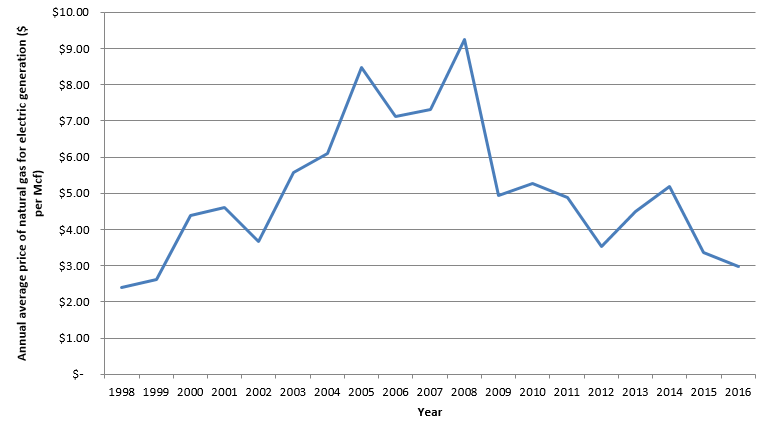 Click on the image at right to see annual average cost of natural gas for power producers.
Gas costs have fallen because gas production continues to grow at several major unconventional formations. Gas production is averaging about 19 billion cubic feet per day (Bcf/d) at the Marcellus shale, nearly 8 Bcf/d in the Permian and more than 6 Bcf/d in the Haynesville shale, according to the EIA's most recent Drilling Productivity Report. Production also continues to grow in the Utica shale, which lies underneath Ohio, Pennsylvania and West Virginia, close to where many Midwestern coal-fired generators are closing.
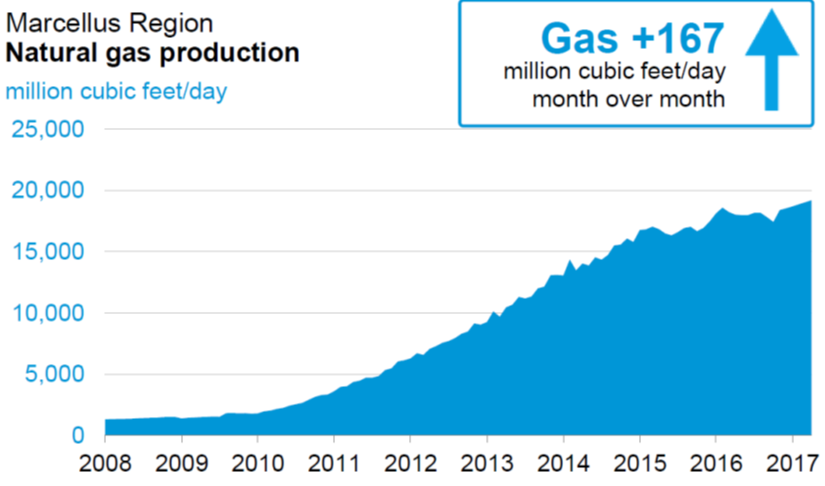 Click on the image at right to see gas production from the Marcellus Shale formation.
Between 2010 and 2016, developers brought about 65,411 megawatts of gas-fired power generation online, Britt Burt, Industrial Info's vice president of research for the Global Power Industry, told participants at the 2017 Industrial Market Outlook event held in Houston January 17. Another 14,482 MW of gas-fired generating capacity is scheduled to come online this year, he predicted, drawing on Industrial Info's North American Project Platform.
In his presentation, Burt added that Texas, Pennsylvania and Ohio are the states with the greatest amount of gas-fired power plants under development for the next few years. For the 2017-2020 period, the Lone Star State has 20,298 MW of projects scheduled to begin construction. Construction of roughly 10,400 MW of gas power plants is scheduled to begin in Pennsylvania between now and 2020, and dirt is scheduled to be turned on more than 8,000 MW of gas-powered generating stations in Ohio over the next four years, he told Outlook attendees January 17.
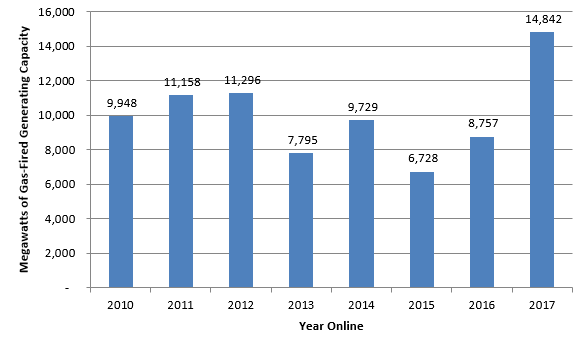 Click on the image at right for a chart summarizing the years new U.S. gas-fired generation came online, 2010-2016, and what is expected to begin operating this year.
 "Natural gas is the dominant fuel for electricity generation," Burt told attendees at the Outlook event. "The future generation mix in the U.S. will be affected by gas prices and electric prices."
Earlier this year, the EIA said natural gas, because of its low cost, became the top source of U.S electricity generation on an annualized basis for the first time in 2016. An estimated 34% of electricity was generated from natural gas last year compared to about 30% from coal, the agency noted.
Increased reliance on gas-fired power has helped cut the industry's emissions of CO2 and SO2, EIA noted in separate reports released earlier this year.
Carbon emissions from electric generation fell to 1,803 million metric tons for the 12-month period between October 2015 and September 2016, continuing a 10-year downward trend, EIA said. Transportation CO2 emissions rose slightly to 1,893 million metric tons during the same time 12-month period. Natural gas has about half the carbon of coal, so it's possible that increased gas consumption by electric generators will still result in lower CO2 emissions from that sector compared to historical reliance on coal.
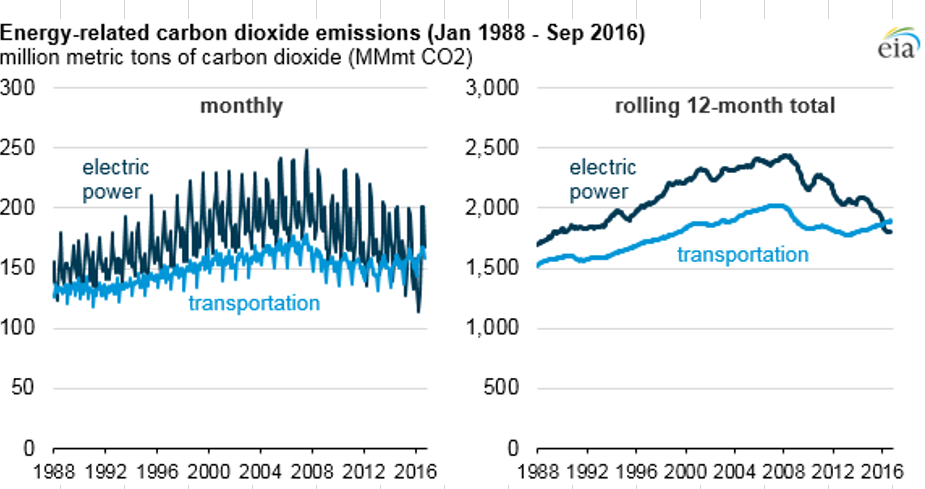 Click on the image at right to see CO2 emissions from the power and transportation sector.
Finally, increased use of natural gas, coupled with broader deployment of scrubbers, is reducing the amount of SO2 in the air, EIA said in a third report.
Sulfur dioxide (SO2) emissions from U.S. power plants have fallen 73% from 2006 to 2015, a much larger reduction than the 32% decrease in coal-fired electricity generation over that period, EIA said in a February 3 "Today in Energy" report. On a year-over-year basis, SO2 emissions from power plants fell 26% between 2014 and 2015, the most recent year with complete power plant emissions data. That one-year decline was the largest annual drop in percentage terms in the previous decade, the agency added.
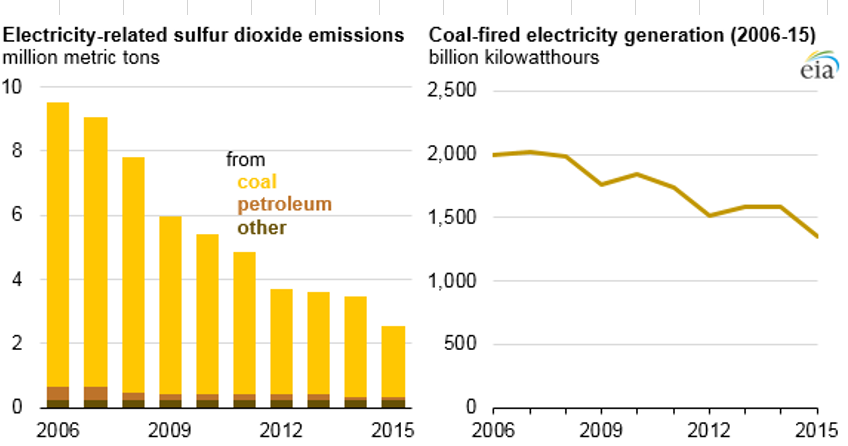 Click on the image at right to see the decline of SO2 emissions compared to the reduced use of coal in power generation.
"Increased use of natural gas in power generation is generating important economic and environmental benefits," Industrial Info's Burt commented. "The rising reliance on gas-fired generation in some areas is something to be watched. But absent a price spike, which is hard to see right now, we expect to see gas continue to gain market share at the expense of coal in the electric generation market."
Industrial Info Resources (IIR), with global headquarters in Sugar Land, Texas, five offices in North America and 10 international offices, is the leading provider of global market intelligence specializing in the industrial process, heavy manufacturing and energy markets. Industrial Info's quality-assurance philosophy, the Living Forward Reporting Principle, provides up-to-the-minute intelligence on what's happening now, while constantly keeping track of future opportunities. Follow IIR on: Facebook - Twitter - LinkedIn. For more information on our coverage, send inquiries to info@industrialinfo.com or visit us online at http://www.industrialinfo.com.
/news/article.jsp
false
Want More IIR News Intelligence?
Make us a Preferred Source on Google to see more of us when you search.
Add Us On GoogleAsk Us
Have a question for our staff?
Submit a question and one of our experts will be happy to assist you.

Forecasts & Analytical Solutions
Where global project and asset data meets advanced analytics for smarter market sizing and forecasting.
Learn MoreRelated Articles

Industrial Project Opportunity Database and Project Leads
Get access to verified capital and maintenance project leads to power your growth.
Learn MoreIndustry Intel
-
2026 North American Labor OutlookPodcast Episode / Apr 24, 2026
-
2026 European Metals & Minerals Project Spending OutlookPodcast Episode / Apr 7, 2026
-
The Age of Critical Minerals in the AmericasPodcast Episode / Mar 20, 2026
-
2026 Regional Chemical Processing OutlookPodcast Episode / Mar 6, 2026
-
From Data to Decisions: How IIR Energy Helps Navigate Market VolatilityPodcast Episode / Nov 21, 2025