Production
EIA: U.S. Sets Records for Energy Production, Exports
U.S. primary energy production in 2024 set an all-time record
Released Friday, March 28, 2025

Written by Paul Wiseman for Industrial Info Resources (Sugar Land, Texas)--U.S. primary energy production in 2024 set an all-time record at 103 quadrillion British thermal units (Btus), according to the U.S. Energy Information Administration (EIA), whose records extend back to 1950. Additionally, U.S. primary energy exports reached 31 quadrillion Btus, a 4% rise over 2023 numbers, which was also a record. The information was included in the March 2025 edition of the EIA's Monthly Energy Review, released on March 26.
On the production side, the largest growth was seen in natural gas plant liquids (NGPLs), up by 7% compared to 2023. NGPLs are so named by the EIA because before 1980, the term included refined liquids such as gasoline, kerosene and more. In today's terminology, it would more commonly be known as natural gas liquids (NGLs).
Additionally, renewable energy production in 2024 was up by 5% from the previous year and crude oil output was up 2%. Nuclear electric power was up 1% and dry natural gas production was virtually unchanged. The only production drop was seen in coal, which fell by 11%.
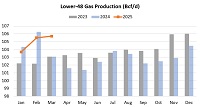
IIR Energy data show the dry gas production for late 2024 and the first two months of 2025 was below that of the previous year, but has moved ahead of 2024 in the last month, according to IIR Energy Natural Gas Products and Senior Energy Analyst Maria Sanchez.
Total primary energy consumption, at 94 quadrillion Btus, was up by 1%. The largest increase was in renewables, at 4%. Natural gas and nuclear electricity consumption rose by 1% each. Coal energy consumption was down by 4%.
Gross primary energy exports were 31 quadrillion Btus, up by 4% from 2023--and the net was 9 quadrillion Btus, "the largest margin on record," said the EIA report. Imports amounted to 22 quadrillion Btus, basically the same as the year before.
Crude oil accounted for about two thirds of the 22 quadrillion Btus of the imports, at just over 14.6 quadrillion Btus. Second at 3.5 quadrillion Btus were petroleum products, which the EIA defines as unfinished oils, natural gasoline and gasoline blending components. It does not include any biofuels.
Top OPEC sources of imported oil include Saudi Arabia at 336,000 barrels per day (BBL/d), Iraq (260,000 BBL/d), Venezuela (232,000 BBL/d) and Nigeria (160,000 BBL/d). In February, U.S. President Donald Trump said he was ending Venezuelan oil imports that were made possible by a venture between Chevron Corporation (NYSE:CVX) (Houston, Texas) and Petroleos de Venezuela (PDVSA).
Neighboring Canada accounted for almost 65% of all non-OPEC imports, and was number one in all crude oil imports at 464,600 BBL/d.
Coming third in imports was natural gas with just over 3.2 quadrillion Btus. Imported coal totaled 0.44 quadrillion Btus, followed by biomass (0.121 quadrillion Btus) and electricity (0.113 quadrillion Btus). Nearly all the natural gas imports came from Canada. The rest originated in Trinidad and Tobago and Norway.
Exports were led by petroleum products' 11.5 quadrillion Btus, followed by crude oil's 8.6 quadrillion Btus, which together accounted for about two thirds of the total of just under 31 quadrillion Btus. Natural gas was third in exports with 7.8 quadrillion Btus. All remaining fuels, fossil and renewable, added up to about 3 quadrillion Btus.
Natural gas export destinations were led by Mexico, which received 2,354 billion cubic feet (Bcf) in 2024, compared with 2,256 Bcf in 2023. Next were Canada (997 Bcf), Japan (336 Bcf), France (355 Bcf) and South Korea (289 Bcf). Other recipients included Brazil, Chile, China, India, Turkey and the U.K. Natural gas exports to still other destinations amounted to 2,071 Bcf in 2024.
Renewable energy's increase was led by solar, which rose to 303.2 megawatt hours (MWh) in 2024 from the previous year's 238.9 MWh. Most of that total came from utility-scale operations, reaching 218.5 MWh compared to 2023's 165.5 MWh.
Industrial Info Resources (IIR) is the leading provider of industrial market intelligence. Since 1983, IIR has provided comprehensive research, news and analysis on the industrial process, manufacturing and energy related industries. IIR's Global Market Intelligence (GMI) platform helps companies identify and pursue trends across multiple markets with access to real, qualified and validated plant and project opportunities. Across the world, IIR is tracking more than 200,000 current and future projects worth $17.8 trillion (USD).
/news/article.jsp
false
Want More IIR News Intelligence?
Make us a Preferred Source on Google to see more of us when you search.
Add Us On GoogleAsk Us
Have a question for our staff?
Submit a question and one of our experts will be happy to assist you.

Forecasts & Analytical Solutions
Where global project and asset data meets advanced analytics for smarter market sizing and forecasting.
Explore Our SolutionsRelated Articles
-
Kinder Morgan Gets Q3 Lift from U.S. Natural GasOctober 23, 2026
-
Winter 2026-27 Outlook: Strong El Niño Expected to Shape Nor...October 23, 2026
-
Long Road Ahead for LNG Recovery, Study FindsOctober 22, 2026
-
BP Taps Technip FMC for High-Pressure Work in U.S. GulfOctober 22, 2026

PECWeb Global Market Intelligence Platform
Identify opportunities, anticipate change, and execute with confidence. PECWeb connects the industrial intelligence you need, from projects and assets to operational events, all in one platform.
Discover PecwebIndustry Intel
-
Brazil Critical Minerals 2027: Rare Earths, Lithium, CopperPodcast Episode / Oct 16, 2026
-
US Craft Labor Outlook 2026: Wages, Per Diems, Data CentersPodcast Episode / Oct 16, 2026
-
Latin America Data Center Outlook 2026: Power, Hubs & GrowthPodcast Episode / Oct 9, 2026
-
Food and Beverage CapEx Outlook 2026: Tariffs, AI, AfricaPodcast Episode / Oct 9, 2026
-
North America Refining 2026: New Pipelines to PADD 5Podcast Episode / Oct 2, 2026