Petroleum Refining
Russia Institutes 6-Month Gasoline Export Ban
Russia on Tuesday announced a six-month ban on gasoline exports
Released Wednesday, February 28, 2024

Written by Paul Wiseman for Industrial Info Resources (Sugar Land, Texas)--Citing the need to tame fuel prices in light of rising demand from consumers, and from farmers as the planting season approaches, Russia on Tuesday announced a six-month ban on gasoline exports, starting March 1.
Reuters quoted Russian media group RBC as saying Russian Prime Minister Mikhail Mishustin "had approved the ban after (Deputy Prime Minister Alexander) Novak proposed it in a letter dated February 21." The goal is to make allowances for rising domestic demand and to allow for refinery maintenance shutdowns. There is also a presidential election looming March 15-17. At election time, low fuel prices tend to benefit incumbents.
Industrial Info's Senior Director, Energy Market Intelligence Hillary Stevenson said, "This export ban is similar to gasoline and diesel export bans the nation instituted in 2023. Unplanned issues shut more than 300,000 BBL/d (barrels per day) of Russian refining capacity on average in February after a heavy maintenance season at the end of 2023. Planned maintenance on top of unplanned issues will push average offline capacity above 600,000 BBL/d in April, according to IIR Energy figures."
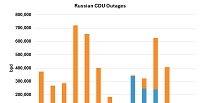
In 2023, Russia exported about 5.75 million tons of gasoline, amounting to about 13% of its production of 43.9 million tons.
Whither From Now?
What does this ban mean to world markets, and especially to Russian gasoline's biggest importers--Nigeria, Libya, Tunisia and the United Arab Emirates? That's the question posed by IIR's Geoffrey S. Lakings. If Nigeria's Dangote refinery had opened on schedule, he noted, it would be processing 650,000 BBL/d of crude into various fuels, including gasoline. But after initial test runs in January, it quickly ran out of crude, leaving its ability to relieve short-term import issues in doubt.
Europe, on the other hand, had already instituted increasing levels of bans on Russian refined products starting in 2022, shortly after the nation's invasion of Ukraine. Some of that difference, mainly in diesel, had been made up by the U.S., which had supplied record amounts of that fuel before February. At least part of the push behind the boost for that market was the security issues around the Suez Canal, limiting imports from the east.
But February was a peak for U.S. refinery maintenance, which reduces production capacity. "Some maintenance projects, namely in the U.S. Gulf Coast, are wrapping up, but we expect a second peak near 1.2 million BBL/d offline in April with mostly U.S. Midcontinent work," noted Stevenson. For the U.S. domestic market alone this is good timing because travel demand is at low tide, being between yearend holiday travel and summer vacation travel.
In answer, Lakings refers to a Commerzbank analyst's take quoted in Marketwatch: "Russian gasoline exports, however, are low, which means the ban is unlikely to significantly affect supply on the global market. As for the European market, imports of Russian petroleum products have already been sanctioned for around a year, with a few exceptions."
An article about last fall's sanctions, from the Carnegie Endowment, notes that Russia has tried to balance between keeping a free market while at the same time controlling prices. Ironically, however, those controls may have the opposite effect. "Artificially low prices, however, have caused energy consumption to remain high and are increasingly difficult and expensive to maintain and would potentially make the economy vulnerable to fuel price fluctuations, when the government would have to abandon the price controls."
Industrial Info Resources (IIR) is the leading provider of industrial market intelligence. Since 1983, IIR has provided comprehensive research, news and analysis on the industrial process, manufacturing and energy related industries. IIR's Global Market Intelligence (GMI) platform helps companies identify and pursue trends across multiple markets with access to real, qualified and validated plant and project opportunities. Across the world, IIR is tracking more than 200,000 current and future projects worth $17.8 trillion (USD).
/news/article.jsp
false
Want More IIR News Intelligence?
Make us a Preferred Source on Google to see more of us when you search.
Add Us On GoogleAsk Us
Have a question for our staff?
Submit a question and one of our experts will be happy to assist you.

Forecasts & Analytical Solutions
Where global project and asset data meets advanced analytics for smarter market sizing and forecasting.
Explore Our SolutionsRelated Articles
-
War, Refineries Keep U.S. Gasoline Prices ElevatedMay 22, 2026
-
Venezuela's PDVSA Continues with Refinery RepairsMay 20, 2026

Industrial Project Opportunity Database and Project Leads
Get access to verified capital and maintenance project leads to power your growth.
Discover Our DatabaseIndustry Intel
-
Innovations Shaping the Next Era of Power GenerationPodcast Episode / May 22, 2026
-
The Role of Contract Manufacturing in Global Pharma GrowthPodcast Episode / May 8, 2026
-
2026 North American Labor OutlookPodcast Episode / Apr 24, 2026
-
2026 European Metals & Minerals Project Spending OutlookPodcast Episode / Apr 7, 2026
-
The Age of Critical Minerals in the AmericasPodcast Episode / Mar 20, 2026