Production
U.S. Oil Export Destinations Need To Shift To Save Europe
It won't be easy for the European Union to pivot away from Russian fuels
Released Tuesday, April 26, 2022
Written by Daniel Graeber for Industrial Info Resources (Sugar Land, Texas)--With few oil producers in the world able to put any meaningful additions on the market, trade patterns may have to shift to accommodate any pivot away from Russian fuels by the European Union (EU).
The re-election of French President Emmanuel Macron during the weekend clears the political calendar so that members of the EU can consider how to move away from Russia's oil and natural gas as punishment for declaring war on Ukraine.
The European Union is bound to Russia by a dense network of pipelines. The continent gets about 25% of its oil and 45% of its natural gas from Russia and replacing those volumes will be no easy feat.
For natural gas, it would require suppliers such as Algeria or Norway to fill the void, though that would depend on available pipeline capacity. Liquified natural gas is another option, though that does little to help any of the landlocked countries that already depend heavily on Russia.
Crude oil too will be tough to replace. The Druzhba pipeline, among the largest in the world, pumps about a million barrels of Russian oil per day to Eastern Europe and into Germany.
To be clear, Russia is the third-largest oil producer and the second-largest natural gas producer in the world. Replacing that will not be easy and any real push for diversification in the EU relies on the sentiment of Germany, which is reluctant to exert any geopolitical pressure due to its Nazi past.
Chancellor Olaf Schulz told German newspaper Der Spiegel during the weekend that he was wary of not only funding Russia's war chest, but about pushing the broader EU economy into recession, when considering a ban.
The loss could be significant. The International Energy Agency said it expects as much as 3 million barrels per day (BBL/d) of Russian crude oil will become untradeable due to sanctions. And there are few other producers able or willing to put more on the market, including members of the Organization of the Petroleum Exporting Countries (OPEC).
OPEC, for its part, has its own problems. Libya is still mired in political conflict a good decade after long-time ruler Moammar Gadhafi was killed, Iran and Venezuela are sidelined by Western sanctions and the de facto head of the group, Saudi Arabia, is seemingly playing politics with its oil reserves. Crown Prince Mohammed bin Salman is said to be refusing calls from the White House, for example.
That leaves it largely to the United States to work to fill the void for its allies. Total U.S. crude oil production was about 11.8 million BBL/d during the four-week period ending April 15, some 7.5% higher than during the same period last year. The government estimates that production could hit a record-setting 13 million BBL/d by next year.
U.S. crude oil exports, meanwhile, averaged 3.3 million BBL/d during the four-week period, up nearly 12% from the same time last year. But it's not the European market that takes in the most crude oil from the United States. It's not even close.
India, over a six-month period ending in January, took in an average 440,660 BBL/d, taking the lead spot among export destinations. In second place, South Korea imported an average of 343,830 BBL/d from the U.S.
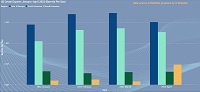
France, the only EU member that took in any significant amount of U.S. crude oil, averaged only about 146,000 BBL/d during the same sixth-month period.
One limit to U.S. crude oil exports is the fact that vessels of the very large crude carrier (VLCC) class need to load up offshore, although ports in Texas are expecting improvements to infrastructure to change that. And while U.S. crude oil shipments may start to move more toward Europe given the looming Russian void, U.S. shipments face a problem unique to North America--hurricanes.
Most of the U.S. crude oil production takes place in southern states along the Gulf of Mexico, and those states are in the direct path of most major hurricanes, which can impede everything from work at offshore installations to inland wells due to flooding.
Forecasters at Colorado State University, in an early look at the 2022 Atlantic hurricane season, expect nine hurricanes and four major hurricanes to develop, a busier season than last year.
From shipping lanes to well performance, hurricanes present a unique challenge for U.S. exports out of the Gulf Coast. Indeed, U.S. crude oil production is accelerating and is expected to fill at least part of the Russian void, though no producer is free of risk.
The Atlantic hurricane season begins June 1 and runs to the end of November.
Industrial Info Resources (IIR) is the world's leading provider of market intelligence across the upstream, midstream and downstream energy markets and all other major industrial markets. IIR's Global Market Intelligence Platform (GMI) supports our end-users across their core businesses, and helps them connect trends across multiple markets with access to real, qualified and validated project opportunities. Follow IIR on: LinkedIn.
/news/article.jsp
false
Want More IIR News Intelligence?
Make us a Preferred Source on Google to see more of us when you search.
Add Us On GoogleAsk Us
Have a question for our staff?
Submit a question and one of our experts will be happy to assist you.

Forecasts & Analytical Solutions
Where global project and asset data meets advanced analytics for smarter market sizing and forecasting.
Explore Our SolutionsRelated Articles
-
Can Canada Really Achieve its Oil Export Ambitions?May 22, 2026
-
UAE Sees New Pipeline Ready by 2027May 22, 2026

Industrial Project Opportunity Database and Project Leads
Get access to verified capital and maintenance project leads to power your growth.
Discover Our DatabaseIndustry Intel
-
Innovations Shaping the Next Era of Power GenerationPodcast Episode / May 22, 2026
-
The Role of Contract Manufacturing in Global Pharma GrowthPodcast Episode / May 8, 2026
-
2026 North American Labor OutlookPodcast Episode / Apr 24, 2026
-
2026 European Metals & Minerals Project Spending OutlookPodcast Episode / Apr 7, 2026
-
The Age of Critical Minerals in the AmericasPodcast Episode / Mar 20, 2026