Production
First-Quarter Profits Soar for Integrated Oil Supermajors
Integrated oil supermajor companies reported very strong first-quarter operating earnings that were boosted by sharply higher crude oil prices, better refining margins and stronger consumer demand compared to year-earlier results.
Released Monday, May 09, 2022
Reports related to this article:
Project(s): View 1 related project in PECWeb
Plant(s): View 1 related plant in PECWeb
Written by John Egan for Industrial Info Resources (Sugar Land, Texas)--Integrated oil supermajor companies reported very strong first-quarter operating earnings that were boosted by sharply higher crude oil prices, better refining margins and stronger consumer demand compared to year-earlier results.
First-quarter cash flows from operations soared as crude oil prices were significantly higher than their year-earlier levels. But quarterly net earnings were dampened by multibillion-dollar charges that were taken by all four supermajors--ExxonMobil Corporation (NYSE:XOM) (Irving, Texas), Chevron Corporation (NYSE:CVX) (San Ramon, California), Shell Plc (NYSE:SHEL) (London, United Kingdom) and BP Plc (NYSE:BP) (London, United Kingdom)--to reflect curtailment or abandonment of business interests with Russia following that country's invasion of Ukraine in late February.
Some of the supermajors also said they were cracking open their purses and planning to increase their capital expenditures (capex) this year, a notable shift from recent years when "capital discipline" meant starving exploration budgets to feed stockholders in the form of dividend increases and special payouts.
Here is a summary of the first-quarter results for the integrated supermajors:
ExxonMobil
ExxonMobil's net income for the just-completed quarter doubled, to $5.5 billion from $2.7 billion in the comparable year-earlier period. Revenue jumped to $87.7 billion from $57.5 billion during 2021's first quarter. Prices for its crude oil rose 28% from last year's first quarter.
Earnings were lowered by a $3.4 billion after-tax charge to reflect the company's exit from its Russia Sakhalin-1 operation, the company said in its April 29 earnings statement. Capital spending during the quarter rose to $4.9 billion, about $1.8 billion more than first-quarter 2021. Most of the increase was for exploration & production, or upstream activities.
Darren Woods, chairman and chief executive, said, "The quarter illustrated the strength of our underlying business and significant progress in further developing our competitively advantaged production portfolio." He cited strong margin improvement and underlying growth as factors contributing to better results, but said some of this improvement was offset by "weather and timing impacts. The absence of these temporary impacts in March provides strong, positive momentum for the second quarter."
Quarterly production declined about 100,000 barrels per day, to about 3.7 million barrels of oil equivalent.
The strong results convinced company leaders to triple ExxonMobil's share-repurchase program to $30 billion through the end of 2023.
In its earnings announcement, the supermajor said it was making significant progress in its lower-emission business, including plans for a world-scale blue hydrogen plant in Texas. The proposed plant would produce up to 1 billion cubic feet per day of blue hydrogen and include one of the world's largest carbon capture and storage (CCS) projects, doubling the company's industry-leading carbon-capture capacity and providing a potential anchor for the ambitious Houston Industrial Hub emissions reduction project.
While ExxonMobil exceeded investors' expectations for revenue, it underperformed expectations for earnings. Its shares fell about 1.5% the day it announced earnings.
Chevron
Quarterly net earnings more than tripled for Chevron, to $6.3 billion compared to $1.4 billion in the comparable year-earlier quarter.
Announced April 29, quarterly earnings were plumped by sharply higher crude oil and natural gas prices. Crude oil and natural gas liquids sold for an average of $77 per barrel during the just-completed period, up 60% from year-earlier average prices of about $48 per barrel. Chevron sold natural gas at an average of $4.10 per thousand cubic feet in the first quarter of 2022, nearly double the $2.10 that product fetched in the first three months of 2021.
For more on Chevron's first-quarter earnings, see May 2, 2022, article - Chevron Eyes More Activity in Permian, Gulf of Mexico as Profits Soar.
In announcing earnings, Mike Wirth, chairman and chief executive, said the company was "doing its part to grow domestic supply with U.S. oil and gas production up 10% over first quarter last year. Consistent with our plans, we're investing to grow both traditional and new energy business lines."
The company's capital expenditures during the quarter increased to $2.8 billion, 10% higher than last year. It plans to boost full-year capital spending, including announced acquisitions, by over 50% compared to 2021.
U.S. upstream production was up 10% but overseas production fell 8% for the just-completed quarter compared to first-quarter 2021. Though the company's upstream segment more than doubled its quarterly operating earnings, to $6.9 billion from $2.3 billion, Chevron's downstream segment also dramatically improved its quarterly operating profits, to about $331 million compared to $5 million in the comparable 2021 quarter.
Domestic downstream operations improved due to higher margins and higher earnings from the 50%-owned Chevron Phillips Chemical Company (The Woodlands, Texas). But overseas downstream operations continued to be a problem, losing $155 million on higher operating expenses, lower margins and a $36 million unfavorable swing in foreign currency impacts. In the first quarter of 2021, the overseas downstream business posted earnings of $135 million.
Investors seemed especially disappointed with Chevron's earnings, knocking about $5 per share off the company's stock price the day earnings were announced, April 29. Top-line revenue was about $600 million short of investor expectations, and earnings, while up sharply, also fell short of investor expectations.
BP
BP took a massive non-cash pre-tax charge, approximately $30.8 billion, mostly related to its decision to exit its Russian operations, which turned an otherwise profitable quarter into a $20.4 billion net loss, the company said it its May 3 earnings release. Absent those charges, the London-based supermajor would have reported a net profit of about $6.2 billion for the first three months of 2022. For a comparable year-earlier quarter, BP earned $2.6 billion in what it called "underlying replacement cost profit."
Chief Executive Bernard Looney said, "In a quarter dominated by the tragic events in Ukraine and volatility in energy markets, BP's focus has been on supplying the reliable energy our customers need. Our decision in February to exit our shareholding in (Russian energy company) Rosneft resulted in the material non-cash charges and headline loss we reported today. But it has not changed our strategy, our financial frame or our expectations for shareholder distributions. Importantly BP continues to perform and step-by-step we are making progress executing our (integrated energy company) strategy -- producing resilient hydrocarbons to provide energy security while investing with discipline in the energy transition."
"Resilient hydrocarbons" is BP's term for oil and gas production, refining and biofuels production. The company said it achieved several milestones in that segment in the just-completed quarter.
Looney continued: "Current events emphasize that the world faces an energy 'trilemma'. We need energy that is not only cleaner, but also reliable and affordable. In our view these are not mutually exclusive. This is exactly why we outlined our strategy in 2020 -- to become an Integrated Energy Company to deliver resilient hydrocarbons to provide energy security today, while at the same time, investing at scale to accelerate the energy system of the future."
In another line of business, renewable energy and hydrogen, BP highlighted gains in offshore wind projects and hydrogen. Among its peers, BP has been the most vocal about the need to evolve from an oil and gas company into a broader, lower-carbon, energy firm.
A third line of business, convenience and mobility, reported continued progress in its electric vehicle (EV) charging strategy, inking a strategic partnership with Volkswagen Group (Wolfsburg, Germany) to roll out an EV fast-charging network in Europe and the U.K., announcing a separate plan to invest more than $1 billion in an U.K. EV charging network over the next decade.
Despite the massive first-quarter reported loss, the underlying results at BP were strong enough that a new $2.5 billion share buyback was announced May 3 that will be completed before it reports second-quarter results this summer.
The company credited its first-quarter operating results to "exceptional oil and gas trading, higher oil (price) realizations and a stronger refining" business, partly offset by the absence of its Russian oil and gas business from the first quarter underlying result. BP announced it would exit its Russian oil and gas businesses days after Russia invaded Ukraine February 24.
Shell
The London-based integrated supermajor reported net income of $7.1 billion for the quarter, well ahead of year-earlier results. Refining margins soared while chemicals margins plunged. Crude oil prices were up sharply from last year's first quarter. The company's gas business reported stronger results compared to the first quarter of 2021. The earnings were dented by $3.9 billion after-tax charges related to Shell's decision to take a phased withdrawal from the Russian market.
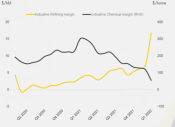 Click on the image at right to see Shell's refining and chemicals margins.
 Cash capex was $5.1 billion for the quarter. For all of 2022, Shell projected capex would be between $23 billion to $27 billion. Last September, Shell announced it was selling its assets in the Permian Basin for $7 billion. The company also sold $700 million of assets in the just-completed quarter. The proceeds of those sales were used to help accelerate debt repayment, fund an $8.5 billion stock buyback program and increase its dividend 4% during the first quarter.
In announcing first-quarter results May 5, Chief Executive Officer Ben van Beurden said, "The war in Ukraine is first and foremost a human tragedy, but it has also caused significant disruption to global energy markets and has shown that secure, reliable and affordable energy simply cannot be taken for granted. The impacts of this uncertainty and the higher cost that comes with it are being felt far and wide. We have been engaging with governments, our customers and suppliers to work through the challenging implications and provide support and solutions where we can."
"Generating value through strong earnings and cash flow, coupled with maintaining a healthy balance sheet and continuing the disciplined delivery of our strategy, are crucial for Shell to play a leading role in the energy transition," he continued. "This allows us to support our customers as they shift to cleaner energy."
Industrial Info Resources (IIR) is the world's leading provider of market intelligence across the upstream, midstream and downstream energy markets and all other major industrial markets. IIR's Global Market Intelligence Platform (GMI) supports our end-users across their core businesses, and helps them connect trends across multiple markets with access to real, qualified and validated project opportunities. Follow IIR on: LinkedIn.
/news/article.jsp
false
Want More IIR News Intelligence?
Make us a Preferred Source on Google to see more of us when you search.
Add Us On GoogleAsk Us
Have a question for our staff?
Submit a question and one of our experts will be happy to assist you.

Forecasts & Analytical Solutions
Where global project and asset data meets advanced analytics for smarter market sizing and forecasting.
Explore Our SolutionsRelated Articles
-
The Green Hydrogen Bubble - A Pop Heard Around the WorldAugust 22, 2025
-
ExxonMobil Expecting Permian Production SurgeDecember 12, 2024

Industrial Project Opportunity Database and Project Leads
Get access to verified capital and maintenance project leads to power your growth.
Discover Our DatabaseIndustry Intel
-
Innovations Shaping the Next Era of Power GenerationPodcast Episode / May 22, 2026
-
The Role of Contract Manufacturing in Global Pharma GrowthPodcast Episode / May 8, 2026
-
2026 North American Labor OutlookPodcast Episode / Apr 24, 2026
-
2026 European Metals & Minerals Project Spending OutlookPodcast Episode / Apr 7, 2026
-
The Age of Critical Minerals in the AmericasPodcast Episode / Mar 20, 2026